Agra: friends, festivals and the Taj

20111008-100411.jpg

In Agra we sought refuge at the delightful Tourists’ Rest House, an oasis of calm from the dusty chaos outside. My food poisoning went from uncomfortable to feverish and there were certainly a few moments when we seriously considered finding the next flight to tamer Thailand! We persevered though and are all the better for it now.

Agra’s a funny unstructured town, without anything in the way of a centre – there are a few different districts which have streets with more shops on, and lots of dusty roads packed with blaring traffic and a blazing sun – but nothing that really feels like you’re somewhere other than a thoroughfare. Fortunately, we found shelter from the heat at a great ice cream parlour near our guest house, where Laura indulged in a chocolate ice cream fantasy – the first frozen stuff we’ve had since setting out. It looked mouthwatering, but I was firmly staying away from anything other than rice and plain toast for the time being!

Our lovely friends Solveig and Gardar from Norway who we met on the Gap tour in China were in Agra at the same time, and so a real highlight was the happy reunion we had with them over rooftop drinks at sunset and then dinner. They regaled us with tales of their recent trip to Sikkim and Butan, a mountain kingdom that’s on the cusp of modernisation after only recently being opened to outsiders. It sounds like a fascinating country, with the Gross National Happiness index (no, really!) taking precedence over more materialistic measures like GDP. They were also near Sikkim when the recent earthquake struck, entertainingly driving down a road at the time that was so bumpy that they didn’t notice the ground shake – but they saw some of the destruction in the places they were staying.

Solveig is also a nurse in her life outside travelling and very kindly provided drugs and rehydration salts to a somewhat out-of-it Simon. Many thanks for that – I’m feeling so much better now!

While we were there, Agra (and indeed India) also played host to Durga Puja, a colourful street festival in which almost every street erects an ornate tented shrine to the goddess Durga. These were on every corner, and ‘tented’ doesn’t really do it justice – this is no marquee. I initially thought some of them were carved from wood, so ornate is the shape of the stretched fabric covering. A great time for celebration – with loud music blaring out of speakers everywhere (including mounted on every telegraph pole down some main roads), festoon lights in red and yellow, and on one of the days, scores of people parading the goddess through the streets, awash with brightly coloured tikka in red, and green, orange and pink.

We visited the Mughal Agra fort, decked in red sandstone with dominating twenty metre high walls. Slightly less impressive was the stench of stagnant water from the putrefying moat – although it certainly encouraged us to pay up and go in quickly! Much like the fort in Delhi, it was a former seat of government, holding a palace and the halls of public and private audience, which were suitably majestic and regal. It also held some features for the amusement of the royals – the ‘fish palace’, with tanks and water channels which could be used to practice fishing, and a (literally) life sized ‘pachisi board’, where the emperor could play the ludo-like game with slave girls dressed in bright colours as the pieces. His father started this practice, and was known to play games with up to 200 ‘pieces’ that would last 3 months! Now I know they say cricket can take quite a long time to play, but I think this takes the record!

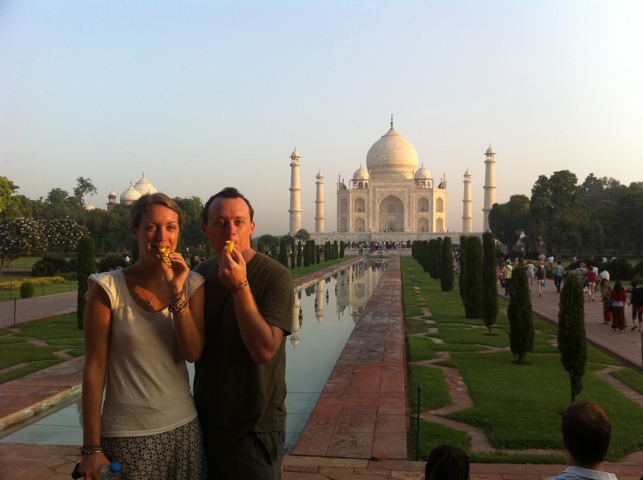
Our final sight in Agra was the magnificent Taj Mahal, which more than met its billing, even at the just-after-dawn time of 6:30 in the morning. Majestic, beautiful, tranquil and intricate, its lines of dazzling white symmetry and perfect reflecting pools are a sight that will stay with us for a long time. One cannot help but be awed by the combination of finely carved marble, glowing a pearly white in the morning sun, set against dark place Koranic inscriptions, and all against a huge blue expanse of sky.

The dedication to symmetry is everything – identical left-to-right as well as of course vertically through reflection in the water. The consequence of this is interesting too – the large mosque to the left of the Taj faces Mecca to the west, but of course the replica to the right cannot as it would break the symmetry – so it remains just an empty replica, perhaps a metaphorical place of worship for those who seek aesthetic rather than religious enlightenment.

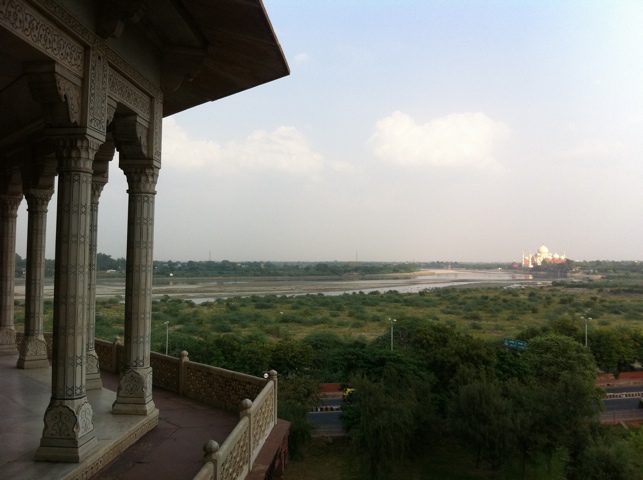
The Taj Mahal has been described as “a teardrop on the face of eternity”, but to me, the saddest thing about this mausoleum of love comes from its minor piece of asymmetry. For next to the perfectly aligned tomb of Mumtaz Mahal lies the mispositioned and asymmetric resting place of her husband and creator of the Taj, Shah Jahan. He spent his final years deposed and a captive of his own son, only able to gaze upon his romantic monument from the Agra fort in the distance, and then buried awkwardly for eternity – appropriately alongside his greatest love and within his greatest creation – but in a way that he never can have intended or desired. But then when you think about it in the broader sense, what more fitting way can there be to cap off a monument to the trials of love?

Simon
20111008-100423.jpg

Delhi doldrums and delights

20111007-184014.jpg

Ah hello! You join us aboard the New Delhi Shridham Express, on the way to Agra. The train’s currently running 2 1/2 hours late, but it is finally moving – and so are we, after a few days to gather (no, not find) ourselves in Delhi.

So, India! It’s lived up to most of the stereotypes so far: hot, dusty, dirty, noisy, crazy, and we’ve both managed to welcome in a new country with its common embrace, Delhi Belly. But on the positive side, the colours are vibrant, the sightseeing awe-inspiring, and we’re warming to the place – especially when not isolated by air conditioning!

It’s hard to capture the sheer feeling of mayhem and confusion you get walking down the street here, but let me attempt to paint the picture. Firstly, the road itself is fashioned from tarmac which has given way to dirt and is decorated with potholes and bumps, and stones and rubbish – so the vehicles are weaving their way along, often on the wrong side of the road to find a clearer path. Ah, yes – the traffic! A combination of hand-pushed carts laden high with boxed goods, bicycles with their bells brring-brring their presence, and horn-blaring rickshaws – cycle-pulled ones like a horse and carriage (with the horse swapped out) in a variety of colours, and a sea of green and yellow auto-rickshaws, essentially a motorbike with some seats and two extra wheels attached to the back. Plus the odd cow, generally emaciated and munching away on the rubbish, often right in the middle of the busiest of roads. Oh, and cars, taxis – and the occasional huge Tata lorry or bus that seems determined to squash you. Did I mention there’s no pavement? Actually, that’s not quite true – sometimes there is a pavement, but only one that truly existed in the architect’s mind, as if the builders didn’t quite know what it should look like and had to guess. Invariably if it does exist, it’s practical in plan view only, for it’ll be 2 feet up from the road – and when you do clamber up (stepladders are not provided), it’s already in use – open manholes into sewers, storage for piles of boxes, chairs for security guards, fences, electricity cabinets. We’ve come to the conclusion (like everyone else) that it’s safer amid the melee on the street!

We were staying in the Pahan Ganj, the tourist area of New Delhi, which is probably the most tourist ‘friendly’ place we’ve been to so far. And by ‘friendly’, I really mean ‘blood sucking’ (vampire squids be warned), at least in any conventional sense. Essentially along with the aforementioned street chaos, everyone is shouting in your direction, trying to extract money from you, whether you look interested or not: “Rickshaw? Rickshaw? I give good price. Taxi to Red Fort? Cheap Hotel! Nice bracelet, authentic jewellery. Dinner sir, western food? Weather raining in England! Indian Helicopter?” (that last one’s a more entertaining name for a rickshaw). It’s quite like the Thamel area of Kathmandu – but with more traffic and pestering – and more heat.

Interaction with those on the street is further confused by the genuine attempts of some people to be friendly and start conversations – uninhibited by the norms around privacy you’d expect in the west. Unfortunately these all seem to consist of the same stock phrases – “You arrive Delhi when? Ah, welcome to
India! In India how many days? Where next stop? How many children you have?” It’s easy to want to be rude to everyone and shut it all out – but some of this (and the hard thing is working out which bit) is actual well-intentioned inquisition and could be great. We’re hoping that elsewhere in India we’ll find fewer touts and more obvious friendship!

As you can probably tell, it’s been a fairly stressful few days alongside the feverish stomach aches! We did manage to see a few sights while were were in Delhi though, which were more than worthwhile.

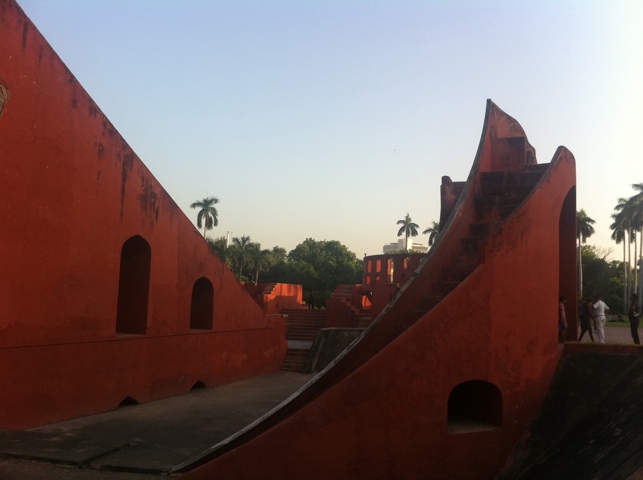
First up, the Jantar Mantar, an open air observatory built in 1725, essentially a park filled with huge stone structures used to calculate time and various astrological measurements such as the diameter of the sun. The structures are a mix of towers and arcs, with a couple of small colosseum-like buildings too, each with a tower in the middle, casting a shadow which was then measured. The bright red sandstone is very distinctive of the area, and set against the shining white surfaces and steps used for the calculations, it looked amazing. Apparently the sundial could report the time of day within two seconds!

We were especially pleased we made it here given we’d been warned off by various locals that there was nothing for a tourist to see. There’s also a con in some parts of Delhi where one scammer squirts poo on your shoes, and then another person turns up, kindly offering to clean it off for an extortionate fee. Given we were both wearing sandals we were very happy we didn’t fall victim to this one!

The following day, despite protestations from rickshaws that it was definitely closed, we went to the Red Fort (which was most certainly open, and teeming with people). A huge red sandstone Mughal monument, it used to be the centre of government and home to the emperor, with 2km of ramparts and numerous internal palaces, which used to have an artificial stream running through the middle of them. There was also a museum about India’s struggle for independence from the British – which was inspiring for the incredible non-violent struggle led by Gandhi. It was slightly odd being Brits going round the museum and being unsure how to respond – compounded by various people asking for our photo with them. Laura and I weren’t quite sure if we should be posing as colonialists or not!

We also went to the ‘Sound and Light Show’ at the fort, which just about met the spec – there was sound (surround sound, no less), and they did illuminate the buildings with coloured lights, but it was a little underwhelming. The narrative, about the history of the fort and the Mughals was at least interesting – and the choice of English at times hilarious, the highlight, about the Empreror falling for a concubine: “The King loved a slut”. It was also pretty astounding to hear the tale of how the Mughals had been laid to ruin by a Persian invader, who essentially ransacked the riches of the city, including a beautiful peacock throne while the king emperor spent his nights and days partying instead.

20111007-184442.jpg
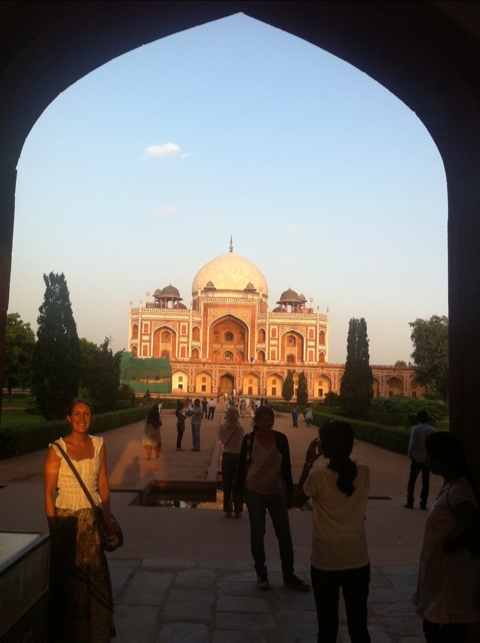
Delhi also has a precursor to the Taj Mahal – a mausoleum known as Humayun’s Tomb. It was amazing – a beautiful silhouette against the late afternoon sky, with gentle chutes of water running toward it. Its tranquility was everything the rest of Delhi was not, and it was a lovely escape. On the way there we were touched by a bit of honesty and hospitality – a rickshaw driver pulled up beside us and offered to give us a lift for the final 10 minutes walk for free. Thick skinned from the numerous other rickshaw encounters, we were dubious and took some convincing – but he told us that we were doing him a favour as he needed to pick someone up from our destination and was duty bound to stop if anyone had flagged him down while empty. Dubious, we thought, exhausted we stepped in, and successful we were! It really brought a smile to our weary faces!

And finally, the Gandhi museum, at the home where he spent the last half year before he was assassinated by extremists. It’s hard to overstate the significance that Gandhi has to India – he’s universally credited as being the father of Indian independence, and achieved it in such a positive and refreshing way – demonstrating that non-violence can be such a force for change. The museum more than does it justice and was enthralling. There were the usual rooms packed with images and lots of text about him, as well as a tour of his living quarters – and more eerily the final footsteps he took before he was killed. But the highlight by far was upstairs – a fairly newly opened digital interactive museum, which was brilliant! They’d used every imaginable way of encouraging interaction with the exhibits – singing, plucking a harp, steering a train, holding hands, turning wheels, moving screens over timelines, and it worked so well! We only wish we’d had more time to spend here – thanks to Ruth for recommending we visit.

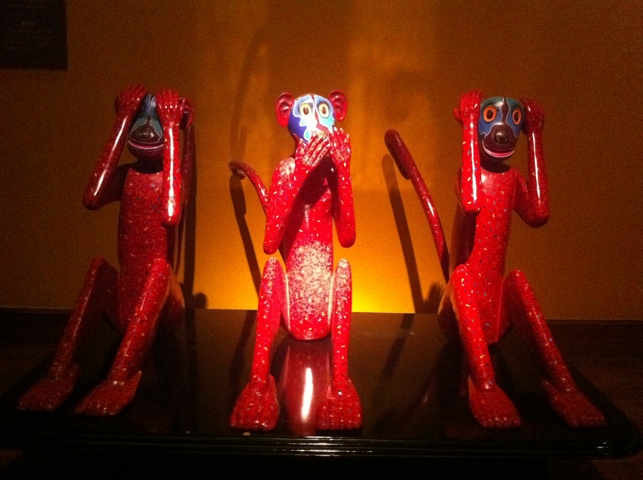
I’ll leave you with a photo of an exhibit at the museum – “See no evil, hear no evil, speak no evil”. One of Gandhi’s few possessions was a model of these three, a fitting tribute to a positive attitude in life.

Simon

20111007-184413.jpg

Happy Birthday Gandhi!

Image

20111002-183713.jpg

Today’s a National Holiday in India in honour of Gandhi’s birthday.

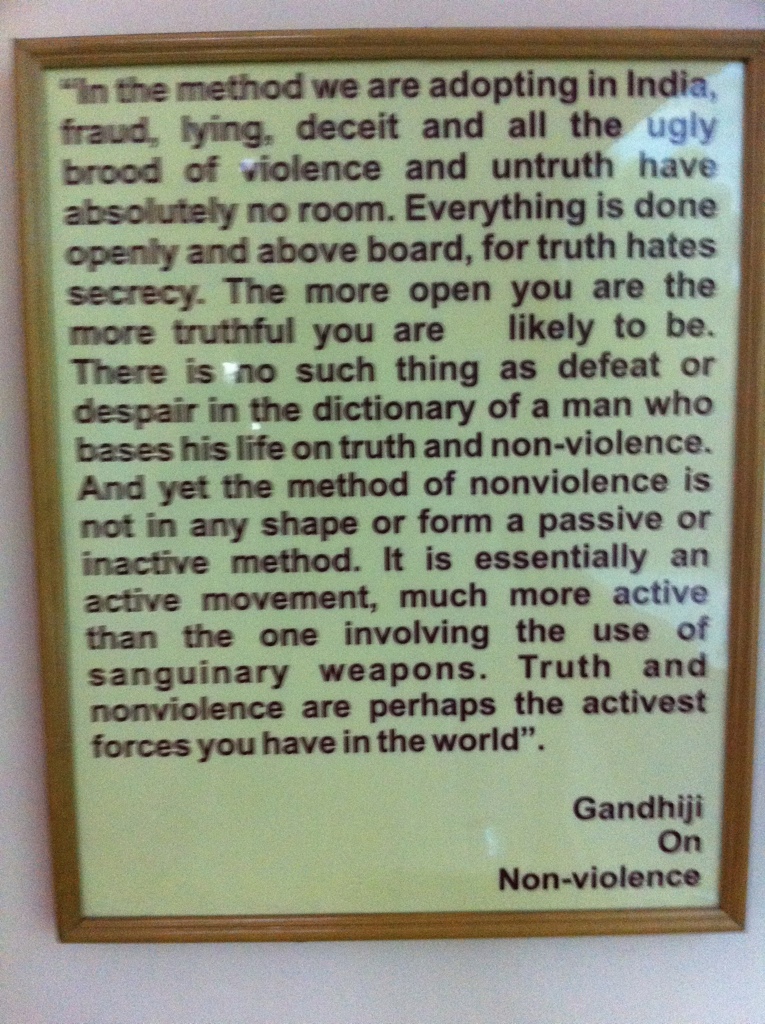
We went round a museum in Delhi today about Indian Independence and saw this quotation there. I couldn’t agree more.

Nepal in the Asian soup

20111001-120629.jpg

Today we leave Nepal, bound for India and the heaving metropolis of Delhi. Behind us we leave a country of mountains, rural beauty – and its fair share of memories over the three weeks we’ve spent there.

Nepal seems determined to stand out with uniqueness and not just disappear into the (noodle) soup of the Asian subcontinent. Its distinctive flag shape is the first hint – two overlapping triangles instead of the usual rectangle – and then there’s the time zone, 4:45 from GMT – that quirky quarter of an hour. While we’re at it, there’s the small matter of which year we’re in, because I’m writing from The Future. It’s 2068 here, at least on the Nepali calendar. I knew we might age a little travelling, but I wasn’t quite expecting to collect my pension so soon!

Then there’s the landscape, which has more of a sense of familiarity, but is still punctuated with distinctions to set it apart from a bland Asian broth. I’ve written enough about the soaring white and grey mountains and the raging torrents (sometimes with bouncing westerners suspended above on elastic cords). What about those bits in between the peaks and valleys?

Paddy fields lining the hillsides in a patchwork of green, with dark green stitching from the borders of reeds. These exist not just on the flat by the river, but all the way up the incline into the distance, on terraces much like you see vines in France. Between them, locals treading the paths with piles of harvested shrubbery so large on their backs that they look like they’re trying to camouflage themselves as tree people. Or maybe triffids. And always nearby, dogs dozing everywhere, basking in and out of the sun, or curled up in piles of dry corn husks, the perfect cosy natural nest.

Where the land hasn’t been cultivated, the paddy motif gives way to rich tropical forest, with plants of all shapes – ferns and palms and soaring trees, and what look like melons hanging from the canopy, with branches all clothed in a fur of soft lime green moss glistening with the condensation of the damp air. From a distance, these living green lungs appear to be fed by bright clay-red arteries slicing through the mountainside, horizontal roads intersected by vertical landslides – an evolving snakes and ladders board between mankind and nature in the journey to conquer the landscape.

Sprinkled throughout this, a seasoning of buildings, from the tall red chimney stacks of the brickworks in the Kathmandu Valley, complete with crumbling mounds of red dust the shape of former bricks, to the ramshackle corrugated iron huts and shelters of the hillside, roofs weighed down by boulders or tyres – or both. Even the more solid, constructed buildings still have a sense of being in flux, due to the plan-for-growth nature of the building style – iron rods reaching for the sky out of every rooftop in preparation for promotion into upward extension should the need – and money – arise. I just hope the skyrises beginning to appear on the Kathmandu skyline have a few more foundations!

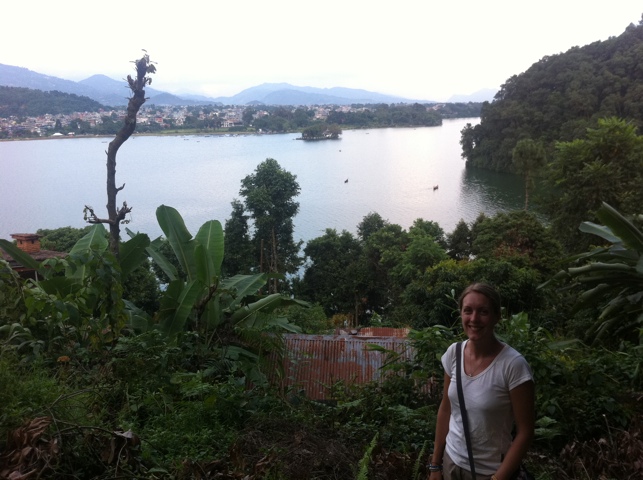
Up close, a spiders web of black plastic pipes crisscross mountain paths – and to our surprise the other day even lakes like the Fewa Tal in Pokhara. These are black plastic hosepipes, carrying water from a nearby stream or pump to a form a continually running supply outside someone’s home, or directed into a refreshing solar shower for weary walkers. It’s fascinating to see even on some of the remotest hill paths the signs of local habitation – even if we can’t quite see where into the jungle the water leads.

I don’t think it would be right to sing about the rural beauty here without adding a melancholy verse on its destruction by mankind. The main problem is rubbish, sprouting like weeds everywhere, as much a part of the scenery as the red clay mud and the grass softly waving in the wind. First there’s the litter marring every hiking trail – crisp packets, and sauce sachets, and plastic bottles. Totally avoidable and caused by laziness by the very people apparently here to appreciate the beauty. Horrible and shameful – and getting worse since it would be a big effort to now clean it up and carry it all out down the mountain. We were, however, expecting this – not that that it in any way excuses it. The thing I wasn’t expecting to see is locals showing a total disregard for rubbish too. The streets in most towns and villages we went through are strewn with waste – and vacant plots on the steep hillside yet to be built on are used as open communal dumping grounds, with rubbish scattered down the hill for hundreds of metres below before it’s consumed by the forest again. It’s unclear what causes this neglect – insufficient funds to organise a centralised rubbish system? Lack of awareness from poor education? Apathy? It’s certainly depressing.

So we say our farewell to Nepal, a mountain country of colour and contrast, where the people on the streets display colours as strong as any mountain flower. A police force dressed in the blue camouflage gear more suitable for a marine environment (and less so for a landlocked place!); beautiful bright saris in orange and red and green, woven with glimmering silver and gold thread and fluttering in the breeze; and deep red tika on foreheads and hairlines, signifying religious and matrimonial commitment. All this colour is only emboldened by the wafting haze and scent of the incense, and in the distance, the chime of a temple bell sounding the prayers of another devotee.

Nepal’s contribution to the Asian soup may from a distance seem insignificant – a mere buffer between the great powers of India and China – but it has a distinctive taste that will remain with us as we journey on.

Simon

Not quite the last resort

So today we have some good news, some bad news, and some good news to finish. Given that we were due to be jumping off a bridge over a gorge attached to nothing but a glorified elastic band, that might be enough to make you queasy, but rest assured!

First up – we did it! We actually went to The Last Resort and bungee jumped today, and are alive (and generally well) to tell the tale. Permit me to set the scene:
a tree-lined gorge in the north-east of Nepal, near the border with Tibet, with a frothing brown river deep down below. Spanning the gap, a pedestrian steel suspension bridge stretched taut between concrete anchors in the mountainside. Not unlike the classic Indiana Jones rope bridge from the movies, only made of steel, well anchored, and safe. Ok, so quite unlike it, but the shape and breadth is more or less right – perhaps 1.5m wide and 100m from end to end. Oh yes, and a drop of about 160m beneath. The people on the ground below that we were aiming for (ok, you don’t aim in bungee apparently but you get the picture) were about the size of baby ants.

So we edged out s l o w l y off the bridge, paused and trembled, spread our arms like birds (no, really we did!) then toppled and tumbled and hurtled and yelped (and screamed), and, well, bounced. And then did it again on the following bounce, with spinning for style points. And in about the time it took you to read that (you did pause for the punctuation, didn’t you?), it was over. 160m (let’s say 140 for safety) in about five seconds. Not bad for a human powered (we had to walk back up) effort!

There’s a great moment after the bungee as you’re being lowered to the ground hanging from the cord and they’re pulling you in to the landing zone on a pole when you can pretend to be superman. Obviously it would have been better to be wearing a red cape, but I felt that singing the theme tune loudly more than made up for it. The guys running the thing gave me a bit of an odd look and I wasn’t sure if for a moment they were going to let go and have me ping back up skywards (arms outstretched of course). Sadly they let it pass. Reverse bungee? Gotta be possible, right?

Anyway, bungee good, two very happy bouncers. Video to follow, once the DVDs we ordered make it back to England and onto the web.

Now for the bad news. Late afternoon we went to move into our tent for the night, only to be told it didn’t exist. Some communications breakdown between their office in Kathmandu meant that even though we’d paid in full a few days before, we didn’t have beds. They offered us a festival style dome tent instead but given that this was meant to be a luxury resort, it didn’t quite cut the mustard.

And so to the concluding good news : a full refund! It may have had something to do with our dashing good looks; it may have been thanks to our witty charm and scintillating conversation; or it may have had something to do
with a conversation that involved angry faces, slightly raised voices, and possible mention of the words ‘honeymoon’ and ‘my wife and I’*. (In case there is any confusion, Laura and I are not married or indeed together, happily or otherwise). The bungee thrill of earlier tastes all the better in retrospect now that it cost us nothing. How about that for a rebound!

So the gift of the Last Resort from my generous team at work (hello Market Risk) becomes the gift that keeps on giving – we’re now planning where to spend it next!

The change in plans means we now have a couple of days in hand, so the current idea is to quit Kathmandu (where we now are, yet again) tomorrow, for the lovely lakeside Pokhara, before heading on to Delhi and our lovely Norwegian friends in a few days time.

Simon

* It was very tempting to pepper the conversation with unhelpful but location-humorous phrases like “there’s no choice”, “the final straw”, and (obviously) “the last resort”, but we felt that might undermine our argument and indicate that we were slightly enjoying ourselves.