Bungee Videos

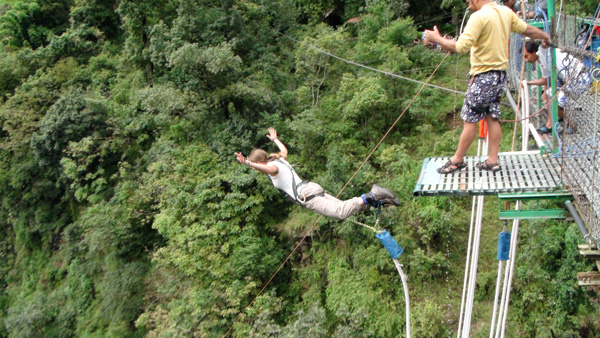
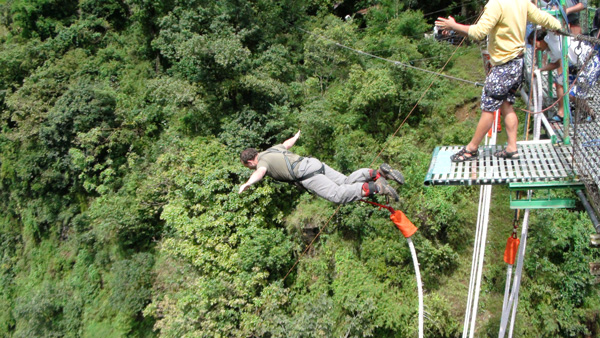
Here are our videos of the Bungee jump we did a few weeks ago at Last Resort in Nepal. Many thanks to Laura’s Dad Alan for uploading these so quickly!

As you can see, we enjoyed it – thanks again to Market Risk for the leaving gift that funded our leap 160m off a bridge…

Laura

Laura's jump into the abyss

Laura's jump into the abyss


Simon

Simon's leap of faith

Simon's leap of faith

Golden cities & camel trekking

20111015-163143.jpg

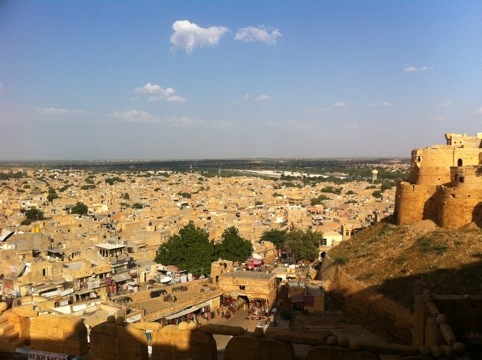
Jaisalmer (pronounced like Haselmere) is known as the golden city thanks to its honey coloured sandstone streets that emerge from the dust and heat of the desert. The city lies on the edge of the Thar desert, a parched land in the far northwest of India 100km from the border with Pakistan. We’re closer to Karachi than Delhi, and the furthest west we’ll be during the Asian part of our travels.

I don’t think any description of a desert land is complete without some mention of the temperature and an unscientific reference to egg cooking time. So for the record: it’s very hot and dry here, albeit only touching 37C on the forecast, and the midday sun is scorching – certainly hot enough to fry an egg on a car bonnet in 30 seconds or so – although with all the dust I’m not sure we’d eat the egg if we did cook it! Actually, it’s hot enough that for the first time we’ve had to seek shelter during the middle of the day and explore during the cooler hours.

The city holds one of the world’s oldest living forts, with 2000 people still inhabiting the houses of the hilltop fort at its centre. While not as vast and dominating as that at Jodhpur, the fort itself is nonetheless impressive – a golden spectacle rising 100m from the town below, with the usual twists and turns on its entry road to prevent invaders from building up enough speed to batter down the defences. It was never successfully taken by force, with the three times it was overcome only after sieges lasting many months forcing those inside to admit defeat and ceremonially surrender in a desperate act – the women by throwing themselves on a ritual fire dressed in all their finery to the beat of a drum, and the men in one final fatal battle charge knowing they were outnumbered and hoping to take as many of the enemy with them as they could.

Despite its impressive past, this is now a citadel in crisis – the modern day development of having water on tap has outstripped improvements to the fort’s old sewer system, and as a consequence a large proportion of the water used in the fort seeps into the foundations beneath, causing collapses and in a few recent occasions catastrophe. Tourism has a large part to blame, and the advice is to stay outside the fort (as we did), or only use one of the older, eco guesthouses within.
20111015-163201.jpg
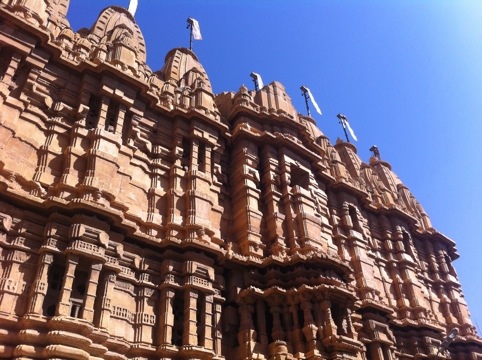
The fort plays host to a number of temples, including an ornate Jain complex from the 16th century, as well as a palace. All are decorated in fantastically detailed stone panels, carved with such precision and deftness that you’d think it was wood. Set against the dazzling blue sky, these golden monuments really look stunning, and all the more so for remaining so detailed after hundreds of years facing off to the abrasive desert winds. In addition to human inhabitants, the buildings of the fort also accommodate an impressive range of bats – almost every indoor corridor had its ceiling dotted with them, sleeping and occasionally stretching and yawning just above our heads.

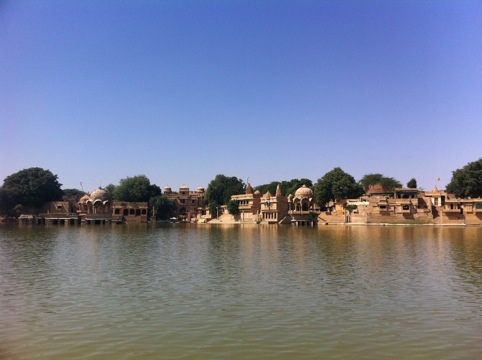
Earlier today we went down to the lake which used to be the town’s only water source. We hired a pedallo and were able to admire the reflections of town and fort upon the water – and at the same time reflect for ourselves what an importance this site must have been before the days of taps and pumps, when the womenfolk of the fort would walk the two kilometres downhill to collect water each day, and when various architectural features of the palaces were first designed to retain every last drop for recycling such a precious resource. It’s just such a pity that today’s throwaway world has seen this quite literally undermined through careless and thoughtless wastage, or to look at it another way, through unbalanced, short-termist development – improvement in water in without matched improvement in the sewerage system to get it out.

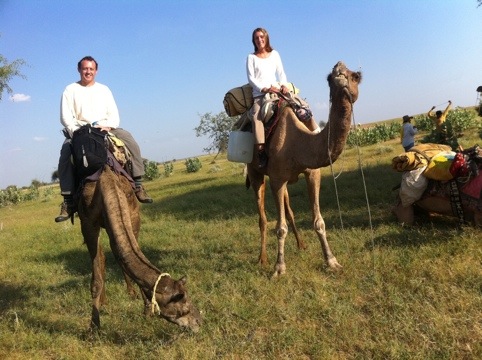
The highlight of our time in Jaisalmer was undoubtedly a camel trek we took into the desert, over two days with a night under the stars in between. We set off early one morning by jeep to our starting point an hour’s drive out of town, where we met our camels and guides. We were fortunate to be just four in total, having been joined by a German and a Cuban girl from our hotel, who made up for in enthusiasm what she lacked in English!
20111015-162955.jpg

Camels (or in our case, single-humped dromedaries) are strange animals, a true dinosaur of the desert which seem to have few present day equals. To look at them and hear them groaning, chewing away at the bushes, and scratching on branches to destruction, you could well think you were watching a scene from Jurassic Park. They stand at easily over two metres high, with impressively long giraffe-like necks that let them crane to reach the juiciest greenery from up on high. And then there’s the legs which are double-jointed and fold concertina-like to let the animal kneel and sit. It’s a strange multi-stage manoeuvre to go from on the ground to up in the air, but it works, and we fortunately managed to stay on! It brought back memories of our brief jaunt on camels in the Tunisian desert – we missed you Steve!

As we started out in our rolling rhythm, there was one surprise about the desert – it was a lot greener than we’d imagined! No, we hadn’t been conned (we did check our GPS to be sure!), but we’d instead visited at one of the few times when the desert is briefly green, after the rains of the monsoon. It will now not rain again here until next July, when another 30cm or so will fall. On a bed of yellow sand, there was a matting of slowly withering grass, in shades of light green and yellow, interspaced with darker green shrubbery – a low stringy dark green plant with small leaves that clung to the ground that our camels seemed to love, and occasional bushes one or two metres high, with glossy bright green leaves. The camels were blighted by flies and in an effort to rid themselves of the irritation, they would crash into these larger bushes, creating a fantastic ripping and tearing sound as the branches and leaves were torn off, and we as riders clung on. However, as Laura found to her peril, the most dangerous obstacles were the spiney, prickly thorn trees that were apparently perfect to scratch that camel itch that apparently no other bush could reach. Unaware of the plight of their human rider, the camels occasionally plunged sidewards into one of these, at one point scratching Laura’s hand and arm
in the process. Fortunately we’re both generally still intact from the experience!

We stopped at a village along the way, where bizarrely Laura got her nails painted in what must be the strangest cultural exchange of the trip so far! After being shown around the simple thatched hut the family lived in and taking the customary photos of the kids posing in our sunglases, the woman pulled out a container of sparkling red nail varnish, and kindly, if not that accurately, decorated Laura’s fingernails. There was a slight moment of horror when she apparently reached to also paint Laura’s nose the same way, but we were relieved to find she just left a small bindi-like spot of red on the end of her nose instead. Even as I write this, I can see Laura’s nails sparkling as a testament to our cultural interaction – still there despite the very best efforts of nail varnish remover last night!

Food in the desert was cooked by our guides over an open fire, delicious and fresh. Each meal was accompanied by handmade (in one case by Laura) chapattis, along with a tasty veg curry and green – but apparently ripe – oranges.

The creatures of the desert were interesting not for what we saw of
them – thankfully very little – but more for the evidence of their presence and survival amid the hostile sands. Holes of varying sizes dotted the sand, some just a few millimetres across, some a couple of centimetres, and others more a warren of tunnels for desert foxes or rats. We didn’t really want to dwell on the creatures of the smaller holes – beatles, certainly (and we saw some rolling dung back with them), but spiders? Scorpions? Fortunately we didn’t need to find out!

As you can imagine, in this context, it was with slight trepidation that we lay down to sleep after a beautiful desert sunset. Our guides had made wonderful beds of clean white sheets and blankets right on the sand, and Laura and I had the privilege of a whole dune to ourselves, with only the starry night sky above and nobody else in sight. The full moon slightly undermined our ability to see the stars but it was a brilliantly beautiful way to sleep, and I was relieved in the morning to find the only close visitors we’d had were beatles, whose tracks decorated all the surrounding sand. Slightly further away was the small wavey track of a small snake that had been past, but we were assured there was nothing hazardous to us.

I never cease to be amazed by dawn, and sunrise in the desert did not disappoint. The gift of day is carefully packaged, and witnessing nature unwrap it is a methodical but wonderfully gradual process.

Before it all begins, there’s a change in the music – a gentle dimming of the night humming of crickets, and an almost imperceptibly slow crescendo of tweets and chirps and caw-caw bird calls, which will build into a fanfare. Then the unwrapping begins. The first layers offer the prize of contrast and shape – the ability to distinguish between the curves of the dune we’re lying on and those of the next; the texture of the sand and its many animal prints from the night; and the first hints of silhouetted trees against the lightening sky.

Then comes colour. The dull colour wash of the moonlight is repainted with ever more vivid highlights – the sky taking on streaks of pink and light blue, giving way to oranges and turquoise, while the sand around us becomes ever more golden and the shrubbery take on their daytime palette of glossy greens and yellows, over rough browns and blacks. It’s almost like discovering sight all over again – as you look around you’re convinced that sunrise must now follow as all the colours of the day have arrived, only for another to emerge from its slumber – a deeper hue of green in the trees, a stronger pink in the sky, an even brighter white in the sheets of our beds.

Finally, the sun emerges, bringing with it incredible blinding brightness, and with that, shadows and the absolutes of black and white – the crisp outline of the distant trees against the glowing sky, and the full shape of the mounds of sand around us as the shadows work their magic and depth comes into play.

Less than a minute later the unwrapping is complete and the day is on full show, the whole glowing sun providing a reminder that we’re in the desert with its lasting final sensation – that of heat, and the need for us to pack up our beds for the night and find shelter in the cool shade of the trees before continuing our journey for the day.

Simon
20111015-163211.jpg

Forts and festivals

20111011-204009.jpg

We had two hopes for our time in Jodhpur – that it would live up to the moniker ‘the blue city’, and that we would catch sight of the famous horseriding trousers in their place of origination (they were invented here for an English gent during the times of the British Raj, and he started a fashion trend). Sadly only the first came true, although the festival we discovered shortly before we arrived more than made up for the lack of riding leather!

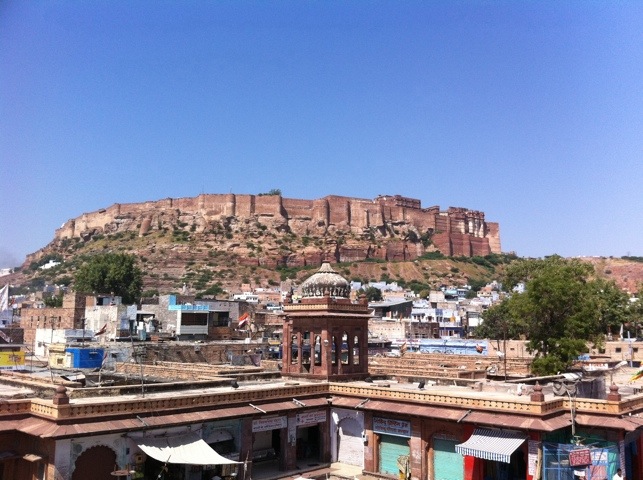
The fort here is simply magnificent! I thought that after the last two I had perhaps run out of fort superlatives, but this really deserves credit and is a real highlight of our visit to India so far. Firstly, it’s massive, dominating the skyline above the expanse of the million-strong city beneath, and providing commanding views for miles around. Secondly, it has the best audio tour ever (and it’s included in the price).
20111011-204019.jpg

Titbits picked up include the sad tale of the man who volunteered (although we’re wondering quite how optional it was) to be buried alive in the foundations of the fort to rid it of a curse from the former occupant; the handprints of queens past who in their final departure from the palace would make a vermillion imprint by the door before joining the king on his funeral pyre in the (thankfully now banned) practice of sati; and the cleverly disguised decorative alcoves up high in the king’s reception chamber which provided a place for female royals to listen in to the advice he was receiving so they could later provide a helpful comment or a counterpoint. In light of recent moments of amnesia Laura believes this is actually because the women could remember what was said!

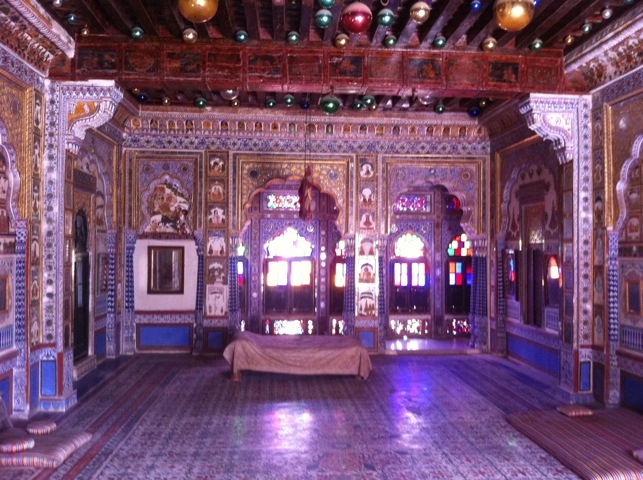
The palace in the fort was also brilliantly beautiful, with the soft light coming through the brightly coloured stained glass shining on the smooth sandstone walls. There were a couple of rooms that made Laura actually gasp with delight when they came into view, including a bedroom – complete with slightly out of place Christmas baubles – that we would have gladly swapped for our hotel room at almost any price!
20111011-204031.jpg

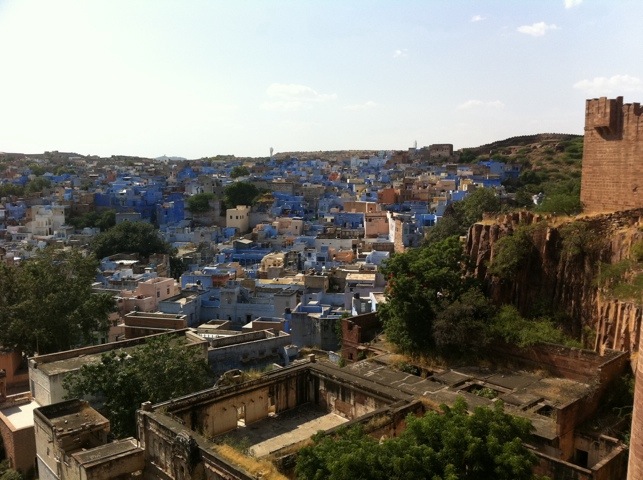
The rich history of the fort was told with an emphasis and nuance missing from so many of the guides we’ve had so far on our travels, and this was complemented by the views over the city below. Many more than in the pink city, Jodhpur’s walls are frequently painted in light blue to serve two purposes – apparently as cooling during the hot summer months (not quite sure about the physics on that verses the usually preferred white), and as a natural insect repellant (again, not quite sure about the biology there…). Still, it looks great, with the cube-shaped houses of the old city rich in colour to match the fort’s history.

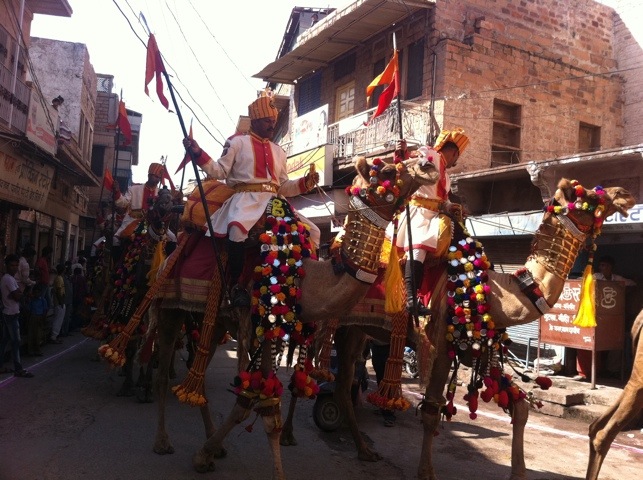
We’d started our day by seeking out the Marwar Festival, an annual celebration of local culture, and found something altogether bigger and more energetic than the drab tourist-targeted flop we’d imagined. There were marching bands! And camels! And actually, a marching band on a camel (the only one in the world)! And we got invited to join in! Ok, so we sat on a cart for a bit, but we were part of the procession through town for a few amazing minutes! The camels were brilliantly dressed, with red rugs fringed in orange, and their necks covered with a glittering web of mirrors and balls of brightly coloured fabric.

As the camel-pulled carts wound their way through the old town, they (and we) were showered with flower petals, most raining down from above, but a few thrown more vigorously directly at us at point blank range (and these were still attached to the flower heads). We’re certain there must be an age-old saying somewhere that you’ve never really experienced local life until you’ve been pelted with flowers and have bruises to show for it!

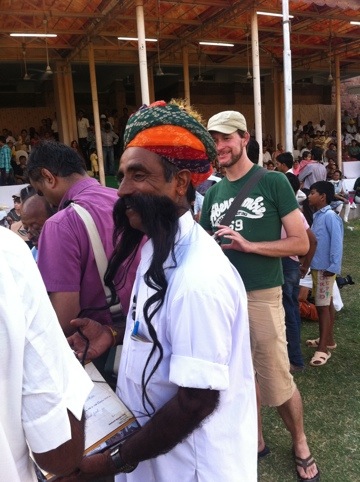
The afternoon of the festival consisted of what was to all intents and purposes an unlikely combination of school sports day, summer fete and military pageant at the local football pitch. There was a marching band competition, of which the highlight for us was the prisoners from a nearby prison. We weren’t quite sure if perhaps it was all part of some elaborate escape bid on their part – an incongruous combination of badly out of tune bagpipes, shaking of tambourines, and drumming that would have been better placed in a samba club. I’m sure there’s a movie in there somewhere once their escape makes the headlines! This was followed by the presentation of prizes – most memorably for best turban, and the highlight – best moustache. The photo speaks for itself, but I’ll just add one thing – the secret is to coil it round your ears for storage!

20111011-204039.jpg
The Border Security Force is the army unit responsible for border control in India – which is a pretty sensitive and important topic given frequently frosty relations with Pakistan. So we were amused to find they were the providers of the final two pieces of entertainment. The BSF choir was pitched as ‘the way the soldiers keep themselves entertained during their time in the barren desert’, and was India’s answer to stomp. Plastic containers, pick-axes, helmets, ammo casings, anti-aircraft missile*, they were drumming on whatever they could lay their hands on – and making quite an impressive sound. We initially thought it must have been a romantic song about leaving one’s sweetheart at home when you went to war, but all was revealed when the true nationalistic chorus kicked in and the audience started cheering: “BSF, march to the sound of the BSF”…

20111011-204050.jpg
To cap it off, there was a BSF Camel Tattoo. Some members of the Kazoo travelling team (who shall remain nameless) thought this was going to involve permanent camel imagery being etched on our midriffs in black ink – and so we were relieved to find twenty five camels with owners marching in various impressive formations, then with acrobatics, and finally with fire. And who says that border patrol is a boring job?!

Simon

*ok, so perhaps not, but you get the picture!

The rainbow of Rajasthan

20111011-110235.jpg

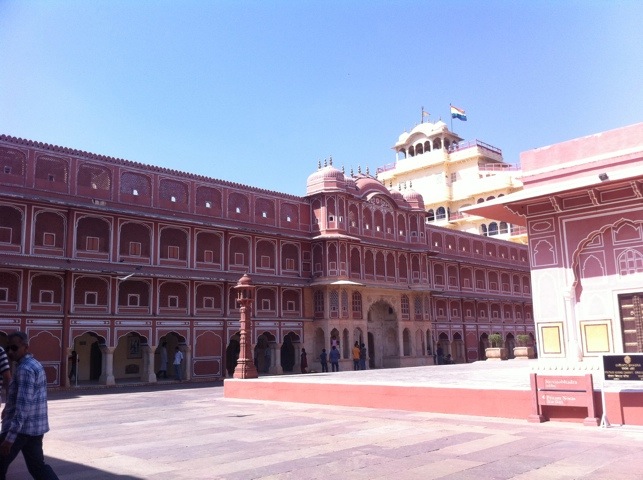
After the pearly white of the Taj Mahal, we’ve headed to the north-western state of Rajasthan to seek out colour. We came hoping for a palette worthy of Laura’s most vibrant psychedelic paintings and so far haven’t been left wanting – and that’s just looking at the first place we visited, with bright red turbans set against the salmon pink of the palace and a vibrant turquoise sky.

Jaipur is the state capital, also known as the Pink City. A large part of the city is painted in salmon pink – not just city walls, but most of the buildings, as well as the aforementioned palace which has offsetting brilliant white detailing to complement it perfectly. We’re slightly unclear why it’s all painted in pink – our guidebooks point to two things: a visit by Prince Charles (yes, that one) in anticipation of which the town was painted in his honour, and a desire to hide the poor quality building materials used in construction. For the sake of artistic integrity, I’m just glad Charles didn’t visit the Taj Mahal in the same trip!

We quite liked Jaipur. It’s noisy and bustling and polluted, but it has a centre, and a sense of purpose that we didn’t find on the throughways of Agra. Here we also found a place that does killer (in the positive sense!) samosas, and a bright, clean and homely guest house. In fact, we liked it so much that we’ve decided to come back here for Diwali in a couple of weeks – it’s meant to be one of the best places to see the festival in India.

20111011-110255.jpg
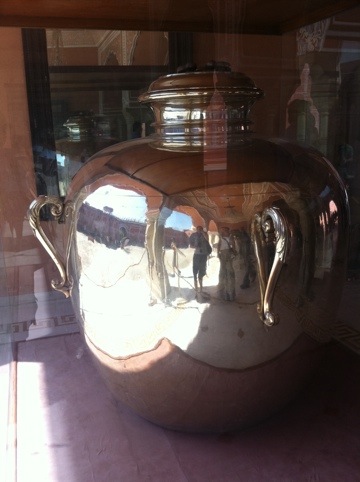
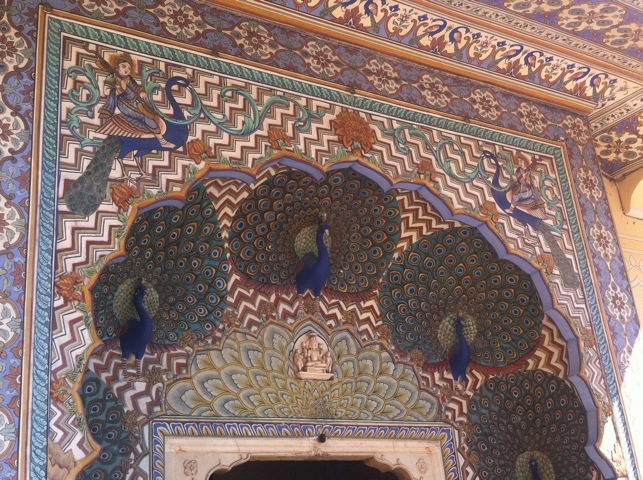
On the sightseeing itinerary, we checked off (it’s becoming a little repetitive!) the two palaces, which were magnificent. The City Palace, still home to some members of the Rajput royal family, has a courtyard with four stunning painted doorways – see the picture above. Also there are the largest crafted silver objects in the world – two urns, 1m high, capable of holding 8182 litres of water. These were used by ruler Madeo Singh II when he went to London in 1901 to attend the coronation of King Edward VII – in an irony that wasn’t lost on us as we sipped from our bottles of mineral water, he was so concerned about the quality of water in the west that he had these filled from the Ganges and brought with him!

20111011-110101.jpg

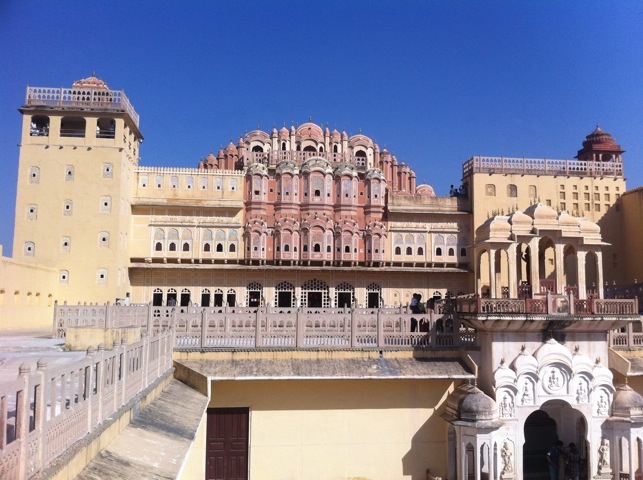
Palace number two – the Hawa Mahal – is really one large facade, on five stories, built as a set of intricate one-way screens to allow the women of the court to watch street processions while remaining out of view. Fabulous views on the modern day traffic jams below!

20111011-110604.jpg
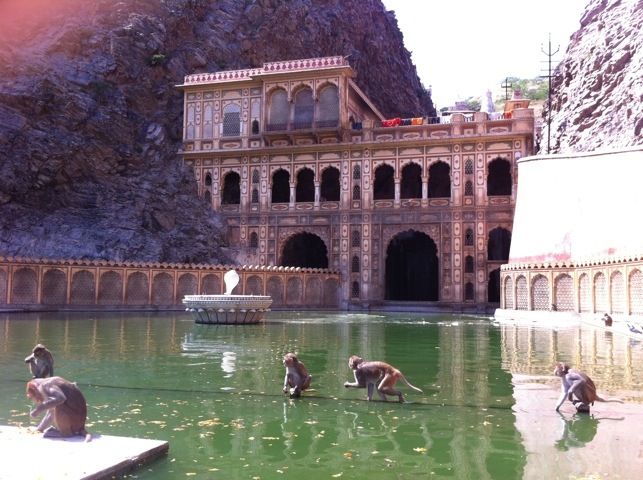
Our second day in the city was a chance to visit the ‘Monkey Palace’ in the hills to the east of the city. This is a set of temples around two pools of water in a gorge, filled by a natural spring, and home to thousands of monkeys, who just like humans love swimming and generally splashing around in the water. It was much like a day down at your local leisure centre (albeit with slightly greener water) – young ones running around screeching and dive bombing into the water, splashing everyone around; older folks having a sedate dip; and mothers with infants perched on the edge carefully checking for nits! I think the only thing missing was the lifeguard, but as we’ve said before, standards of health and safety are a little different here!20111011-110350.jpg

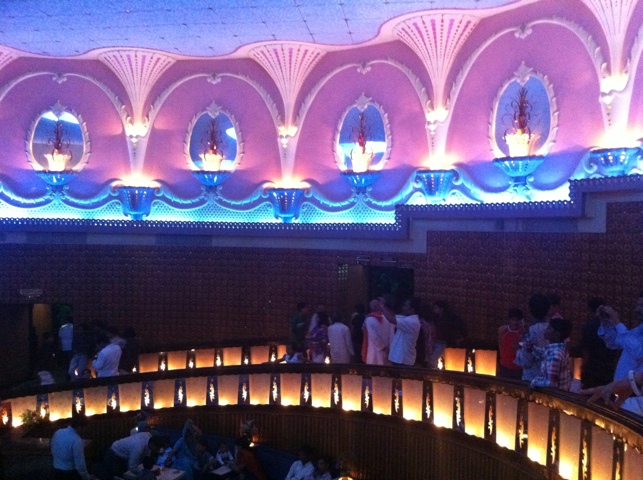
We also took the time to take in two of the city’s more modern sights – the OM Tower, our first revolving restaurant, which had great views of the city if little of edible delight, and then the art deco spectacle of the Raj Mandir cinema. A 1500 seater air-conditioned marvel, it has a lobby appropriately like something out of the movies, a dizzying pinky-blue combination, with neon blue chandeliers and curved staircases among the more standard popcorn counters and fizzy drinks. We saw a terrible Bollywood film (Rascals), but the entertainment came more from the audience than the screen, with cheers, whoops and shouted words of encouragement from the crowd accompanying every event on screen. We were a little surprised when, thinking three hours of film was sufficient, the plot seemed to come to conclusion and it was only the interval – but then we discovered a mere 58 minutes of real time had elapsed, and settled in for the second round! Highly recommended!

Next stop: Jodhpur, the blue city, and home to the famous horseriding trousers.

Simon

20111009-215129.jpg

Change of plan

Just a quick note to say we’ve changed our plans a little for the next month. We had been planning to spend a month in India, but have now realised what everyone else has been telling us for ages – that there isn’t enough time, especially if we want to see a taste of both north and south.

We also want to start our SE Asia journey in Vietnam, which will make it easier to end in Malaysia, and means we can meet up with Simon’s friend Sarah. Very sorry to Tom and Dayna, who this now means we won’t see in Thailand – hopefully we’ll be able to catch up with you a little later on.

The revised plan means we now fly out of India around the 8th November, from Kochi in the south, into Ho Chi Minh City, Vietnam.

We’re currently in Jaipur, leaving tomorrow to continue our tour of Rajasthan, before returning here for a brief respite over Diwali on the 26th October, and then heading to the south of the country by train.

Simon & Laura