Greening the giant

20110910-045624.jpg

One of the stereotypes about China I’ve heard many times is that of a smoke belching, coal guzzling giant. Its massive need for electricity following rapid industrialisation, and the plentiful supply of fossil fuels from it’s vast natural resources means that it is a huge polluter – and one that has an image of being reluctant to adapt to the growing concerns around climate change. Like many other nations, China plays the development deficit card – if the west was allowed to use so much carbon dioxide in getting to its current level of wealth, surely it’s fair to do the same in playing catch-up. Cue a discussion involving modern technology being vastly more efficient, questionable phrases like ‘clean coal’, ‘carbon capture and storage’, and what fairness really means in a world that is currently consuming at twice the rate that is globally sustainable – but where most of that consumption is being done by a small proportion of the population.

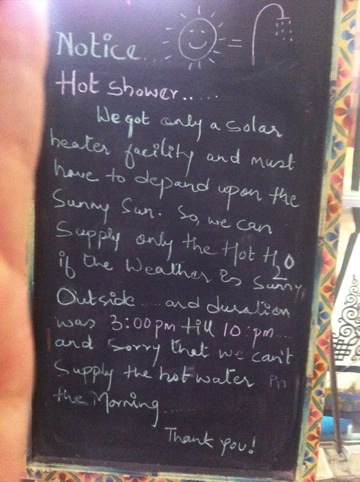
In that context, it’s been interesting to see a surprising number of green shoots of renewables on our journey. Almost everywhere we’ve been, rooftops are decorated with solar water heating, the distinctive cylinders above a slanted set of pipes producing a pretty pattern in a panorama across the roofs of Lhasa. On our train journey across the interior, we passed wind farm after wind farm, with huge turbines lying on the ground in places ready for assembly.

In Tibet, it’s been fascinating to see the streets frequented by solar kettles alongside the motorbike shops and smoke belching tractors. Our guide was telling us that the parabolic mirrors with a kettle suspended in the middle used to be made of cement and take a few people to move around, but recent innovations mean they’re a simple aluminium dish on a portable frame. 20 minutes to boil a large kettle in the high altitude sun – not bad for free energy!

Oh, and Laura reminds me – electric vehicles. The alleyways and side streets here are disarmingly quiet (certainly compared to the cacophony of horns and engines on the main roads). Almost everyone seems to be using electric bikes – from your electric motor-assisted regular cycle, to pimped-up motorbike-sized things. And all absolutely silent. A few times we’ve nearly walked into the path of them (on the pavement, I should point out) because you just can’t hear them coming. I know electric bikes are becoming more common on the streets of Britain, but it’s us playing catch-up here.

I’m sure renewables remain a drop in the (rising) ocean – and many of the pressures to adopt these technologies are financial rather than environmental – but in a land where even in the fresh mountain air of Tibet the locals wear face masks for fear of pollutants, it’s easy to over-apply a single stereotype.

Simon
Reaching for the sky

20110910-065005.jpgYou don’t need to travel here to realise that modern China is about growth and immense scale – but seeing it for yourself really does bring it home.

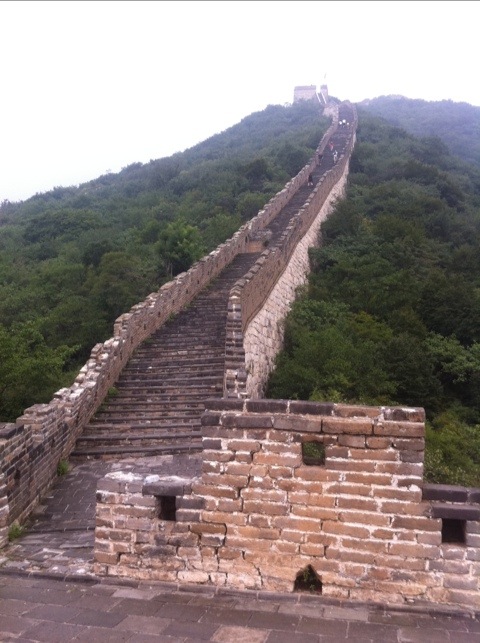
The Great Wall seems to have set the tempo. If a book ‘The Great Wall for dummies’ existed, the first fact it would tell you is that it was not one contiguous wall, but many individual sections, broken up by mountains and other impassable landscape. (The second thing it would tell you is that it’s only as visible from space as motorways, which are wider – and there’s no chance of seeing it unaided from the moon, as has been claimed.) However, saying that The Wall doesn’t go over mountains somewhat understates the effort involved in constructing it. Remember, this is the land of Everest – the sheer, near-vertical rocky ascenders would certainly be called mountains back home. The gentle stroll we were expecting up to and along the wall was anything but – see the photo for a sample of it.

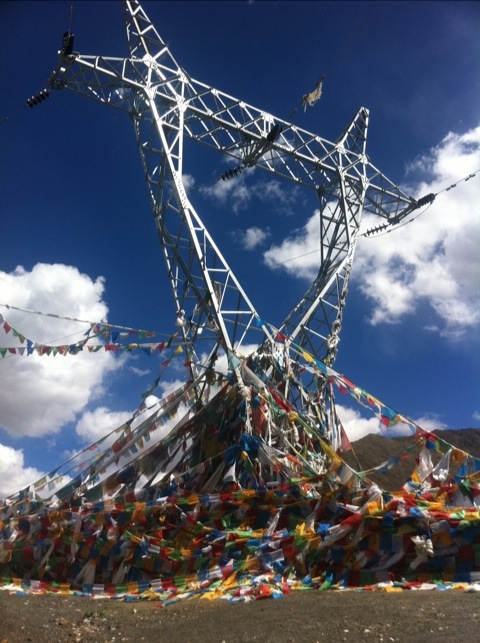
It feels a bit like there’s an attempt to prove that humankind owns and hence dominates the natural world no matter what nature has thrown at us. Take electricity pylons for example. Conventionally you’d expect them to follow the path of least resistance – alongside the rivers that cut valleys through the rock. Not here. Some planner has taken a contourless map and a ruler, and just gone for it, meaning that certainly around the major cities the surrounding mountains have glistening silver monuments to modernity adorning their peaks. I pity the construction workers; nothing short of a helicopter could have been used to shift the materials into place.

20110910-045535.jpg

Even in calm, prayer flag laced Lhasa, the scale of construction is huge. Opposite the hotel where we were staying is a mammoth building site, where they’re constructing the latest shopping mall in China’s enthusiastic embrace of capitalism. Laura thinks I’ve become obsessed by what I’m about to tell you – but let me assure you, it’s nowhere near her addiction to bells (and fountains).

20110910-064735.jpg
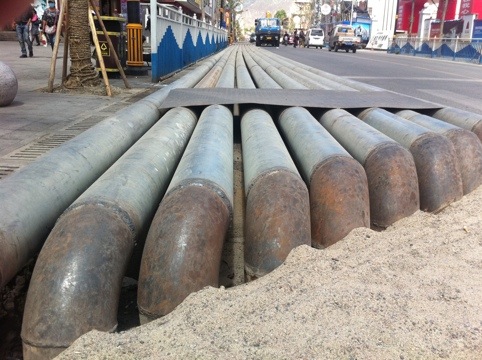
My fascination? They’re using A LOT of water. I don’t mean ‘oh, I left the tap on’, or even ‘let’s run the industrial sprinklers for hours every night’. This is an order of magnitude above: install a whole new set of water mains running above ground for miles across town from at least two different sources. These mains are massive – six or eight welded steel pipes of say eight inches in diameter, running into the distance along the pavement, complete with car-ramps, troughs in the roads so they can cross – and, being spot welded around us while we were there, pedestrian-friendly steps over them. This maze of pipes ends up in four huge water towers, one at each corner of the construction site, into which we could see torrents of water gushing day and night, only to mysteriously vanish again through a network of pipes into the ground around the construction site.

Perhaps they’re creating the world’s largest underground swimming pool? Who knows. This wasn’t what I was thinking of when I said that migration and modernisation was diluting the local culture!

Even the Great Wall has its accoutrement to modernity – a toboggan run from the top down to the car park in the valley below, which we dutifully took in the name of research.

I’m not even going to mention the Ilisu Dam.

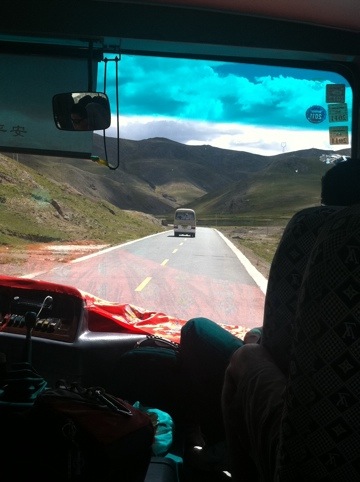
The irony is that as I write this, the busy road from Lhasa has turned into a bmx-style dirt track, with our bus becoming a temporary rollercoaster. For all the prosperity in modern China, it remains a country with extreme contrasts – gleaming urban skyscrapers against a backdrop of massive rural poverty. It may well be the world’s next superpower, but it is one whose GDP is the same as that of Namibia, at $6,000 a year. Multiply that up by 1.4 billion people and you have something colossal – but then when you think of a landscape that stretches from the Himalayas to the Straights of Japan, you realise just how spread out everything is and in reality just how little has been tamed let alone dominated by humankind.

Simon

The bus

20110910-045407.jpg

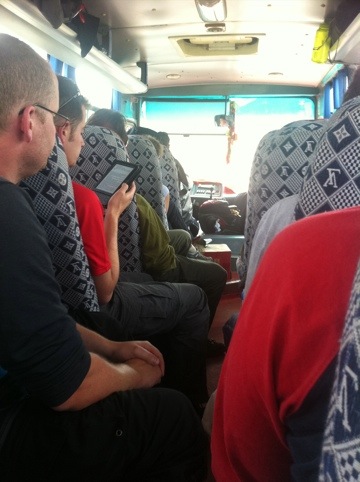
The wheels on the bus go round and round, but the people on the bus go squish and sweat. We have bus envy. Yesterday’s bus had seats with pockets, leg room, and – the holy grail of sunny travel – air conditioning. Today’s is a little more rustic, and the bad news is that this is our transport for the next week all the way to Kathmandu. We won’t quite have the ordeal being experienced by some cyclists we passed while ascending a pass at 4600m, but it’s fair to say we’re underwhelmed by the comfort. Of course this is more than made up for by the adrenaline thrill of hairpin bends and blind corners. I won’t go into a vivid description of the safety conditions on the roads in Tibet for fear of alarming relatives back home. We’ll be ok!

Today’s journey has seen us trundle through the Lhasa valley, following the river downstream to where it joins another and heads off to India. We stopped at a ‘water burial’ site, where the tradition is for the dead to be cast into the river, much like we’ll see at Varanasi in India. Amid the usual prayer flags, an interesting sight on the cliffs alongside the water – white paintings of ladders, to indicate that the dead should climb up to a heaven. Our Norweigen friend Gardar points out that ladders are of course bidirectional, and so an arrow would be a worthy addition!

On we go, past farmers baling their barley into lots of neat little stacks – like a small teepee, with the barley on top fanning out in a cone to keep the rain off. They must make lovely temporary housing for passing wildlife. The bus screeches to a halt as we’re surrounded by Yaks being herded down the valley by a nomad – and later a flock of sheep with their shepherd.

As we reach the pass, a gorgeous turquoise lake comes into view, glistening in the sunshine as far as the eye can see – and reflected in it’s surface, we can see snow capped peaks of a mountain range. Not the Himilayas yet though, we’re told. This lake is a mere 640 square kilometres in size, 240km long.

At each photo stop, there’s an assortment of locals – nomadic peoples who rely on passing tourism to supplement the meagre income they get from farming. Photogenic mothers, dogs with red fluffy scarves around their necks, and of course at least one yak. All, understandably for inclusion in a photo for a fee. We went through a pass at 5020m next to a stunning glacier, and found probably the highest outdoor pool table in the world, with a few locals playing a tournament on it. Amazing!

One last thing for today – prayer flags. It has to be seen to believed. I’m sure you’ve seen the photos of some colourful prayer flags draped across some rooftop, but I’d never realised quite how extreme they get. Every accessible mountaintop, electricity pylon, and pass has thousands of them, in places so dense that they look like a giant fluttering patchwork quilt hanging in the sky. And along with the flags, prayer confetti to release in the wind – oh, and along with that, all manner of rubbish from passing visitors. Beautiful from a distance, up close it can seem somewhat like legal littering, with more manmade rubbish than the last day of Glastonbury (which is bad, if you haven’t seen it!)

One day of the road trip down, five to go. Only a few hours tomorrow, compared to the seven we’ve done today.

Simon

20110910-045427.jpg

And we’re off!

This morning we start our tour proper, piling into the minibus and racing around Tibet for the next week. We’re not sure about Internet – so this could be it for a while (which is probably a good thing since we seem to be addicted to connectivity).

We’ll let you know what we find in due course…

5th – Gyantse
6th – Shigatse
7th – Sakya
8th – Everest Base Camp. Woo!
9th – Zhangmu
10th – Kathmandu

Simon & Laura

From Lhasa with love

20110904-044105.jpg

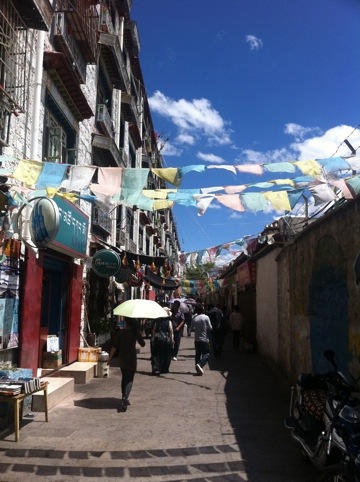
Lhasa might not be a million miles from Beijing (it’s 1500 or so according to my GPS) – but it’s certainly a world apart. Tibetan prayer flags adorn the streets, the people smile at you and are inquisitive, and the Chinese army are on every street corner.

We got here a few days ago, and have been enjoying soaking up the atmosphere while also getting used to the lack of it in a physical sense. Lhasa is at 3600m, which is high enough that you can feel the reduced oxygen – we’ve both had headaches since arriving, and Laura’s having trouble sleeping (and this time it isn’t due to all-night partying!) The advice is to drink plenty of water, rest – and to take Diamox, which aids the body’s absorption of oxygen while enough red blood cells are being created to help out. Fortunately, comfy hotel beds and a pretty chilled out traveller-friendly city makes this a nice spot to rest, although it would be slightly nicer if our hotel room overlooked the delightful courtyard garden at the back rather than the building site and car-horn-aplenty main road at the front.

I’d love to include a set of photos of the various army and police checkpoints around the city – certainly an occupying force by any conventional description. Unfortunately, we’ve been warned they don’t take kindly to this, and they have guns. So I’ll describe it instead. As you walk down the street, you come across four types of military onlookers:

The patrol – normally five soldiers, marching in unison, with white gloves, full body armour, and often riot gear. Between them they tend to carry a few rifles, a shotgun, and what appears to be a tear gas grenade launcher. Oh, and one has a shiny red fire extinguisher strapped to his back, since self-immolation is a common form of protest. Strangely though, they do give way sometimes when the street is crowded.

The box of troops – imagine a small plastic greenhouse, with all the windows shut, surrounded by hazard tape, sitting on a street corner. Now fill it with soldiers in camouflage gear. I’ve heard of guerrilla gardening, but this is something different! Given the sun is very hot here (due to the altitude), it must be like a sauna in there. Maybe there’s a hidden ice-cold plunge pool nearby.

The stage standers – I find this one particularly bizarre. Take a small stage block, say 50cmx50cm, by a mere 20cm high. Paint it bright red, and put a beer garden-style sunshades above it (we’re pretty certain the writing says some pro-Chinese slogan rather than just ‘probably the greatest beer in the world’, but could be wrong). Now stand on it, from your lofty (remember, 20cm!) vantage point and stare into the distance while standing to perfect attention. We’ve been trying to see if they’ll respond to a cheesy grin as we walk past, but so far haven’t succeeded.

The silhouettes – every now and again, against the beautiful skyline of soaring mountains and a brilliant blue sky, you see the outline of a couple of soldiers under another beer garden umbrella. Presumably they’re admiring the rooftop scenery.

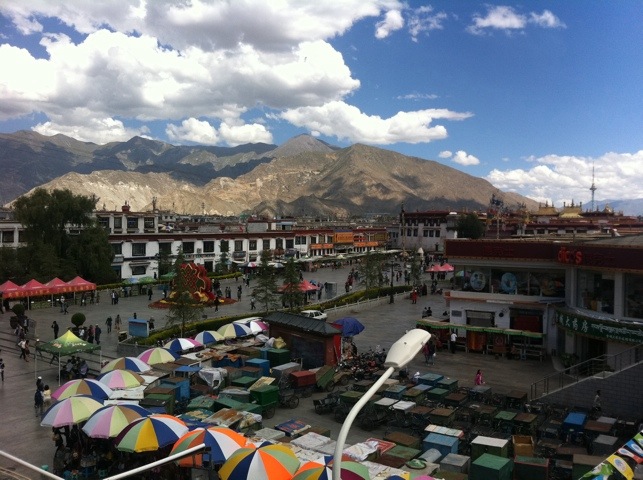
Despite the very visible army presence, this place clearly does have a lot of love. Everywhere you go, there are warm smiles from the locals, and wandering the lovely street market stalls in the Barkhor area surrounding the Jokhang temple, there’s none of the pressured selling we experienced in Beijing, just friendly hellos and questions about where we’re from.

More on the sights, food and, well, yaks later – we’re off to find our first Tibetan geocache and hopefully grab a nice chocolate brownie and a cafe down the road.

Simon

20110904-044043.jpg