Good Evening Vietnam!

20111114-184151.jpg

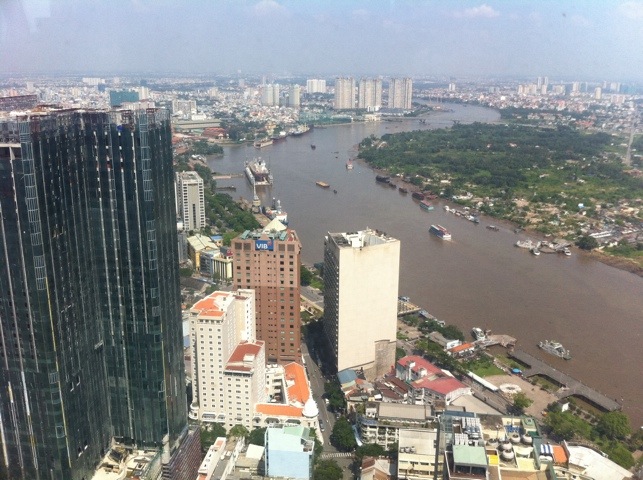
The view over the city from the tower

Having spent an exciting few days in the busy Ho Chi Minh City (HCMC), we’re now on a sleeper train heading north for the calmer town of Hoi An.

It’s consistently an interesting experience arriving into a new country and needing to recalibrate. Obviously there’s the language and currency, but also the street price of everyday items, since in a world with few displayed fixed prices it’s easy to get ripped off. There’s also the question of transport, a somewhat integral part of ‘travelling’! In India, we quickly fell into the routine of rickshaws and trains; here we’re told that for travel in town it’s taxis (ok, but perhaps a bit pricy for us), being a passenger on a motorcycle (err, does that work for two?!), or cyclos, essentially a glorified cot stuck on the front of a pedal bike (which again are designed for solo travelling). We’ll keep you posted on how we get on with these – or whether our feet pay the price for our lack of a sense of adventure!

Fortunately, the trains seem to be pretty good; we’re in one of the less luxurious 6 berth ‘hard sleepers’, which is clean, and even has a door – a feature absent from the Indian trains we loved so much. The only bad thing so far seems to be the lack of boiling water. We brought noodles to, err, instantiate (well, they are instant, right?), but so far – and I’m on the fourth attempt now – there’s only been cold water from the boiler. I think five will be our lucky number though!
20111114-183317.jpg

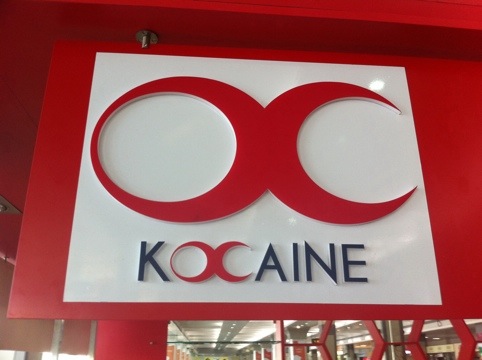
Not what we expecting to find for sale at the airport!


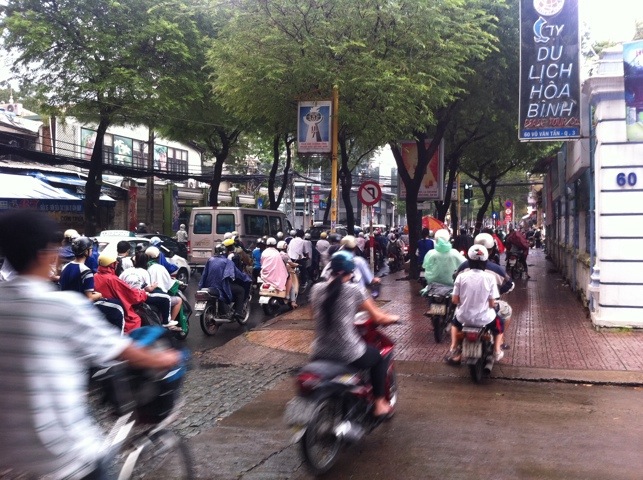
Arriving from India, exhausted after two flights and a nine hour stopover on the hard floor of Kuala Lumpur airport, HCMC was a bit of a shock. It’s like being in Europe! There’s French architecture and boulevards! There are even pavements! Oh, and in a less European feel, there are lots and lots of motorbikes, many on these very pavements!

The rise of the motorbike is a pretty good proxy for the city’s economic rise, itself largely as a result of the tourism the country has experienced since it opened borders to the west in 1989. According to a guide the other day, ten years ago there were 200,000 bikes on the streets, for the 8 million inhabitants. Now there are 4 million, one for every two people. And it really feels like it – a swarm of roaring, screeching, honking two-wheeled insects that seem to get everywhere.
20111114-190837.jpg

Motorbikes everywhere!

It’s hard enough trying to cross the road when there are no lights and just a continual mutating mass of metal and rubber pouring towards you. The trick is just to keep walking forward slowly, dodging only the cars and buses; the bikes will dodge you. However, early on, we made the mistake of trying to cross the city on foot at rush hour – never again! The added complication here is that the bikes also use the pavements as spillover lanes, in their thousands. It’s so common for bikes to use the pavement that the curbs are almost all ramps, for ease of access. It’s the easy cure-all! One-way street getting in the way? Use the pavement! Traffic jam on the tarmac? Stand aside, pedestrians! No right turn? You guessed it! The net effect of the chaos is that every time you cross
a road, you need to look both ways, simultaneously – to monitor both the regular traffic, the bikes on the periphery of the street heading in the other direction, and then the pavement traffic, which can come from anywhere – including the sneaky side-alleys that sub-divide each residential block. At one point on our journey home, we faced a comical (in retrospect, anyway) decision – to wade through the dense stream of bikes coming against us on the main pavement, or to take advantage of some building work that was going on and had cleared some space in which to walk – but doing so meant walking under a guy balanced on a bamboo ladder using a power drill on the cladding of the building above. Having used our best risk assessment skills, we chose the builder’s route, although there was a moment of total panic for me when I thought I heard the sound of breaking tiles from on high!
20111114-184108.jpg

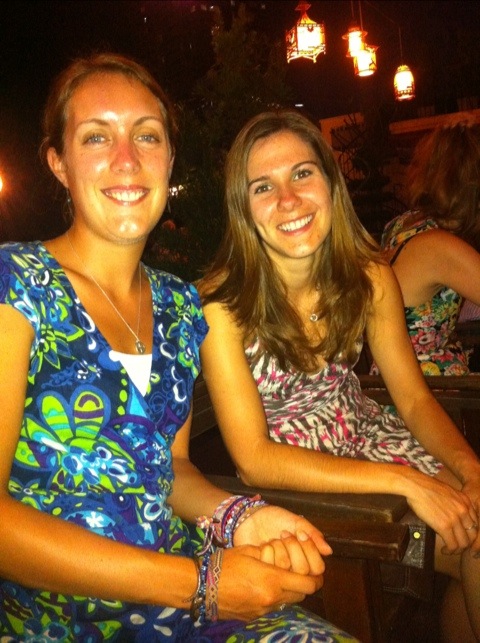
Laura and Sarah on our evening out


Happily, we’ve also been able to meet up with my friend from work Sarah Mann, who’s at the end of a Gap Adventures tour of the country. There’s something fantastically reassuring about seeing a familiar face, and it was great to catch up over food and drinks on a couple of evenings. Big thanks to her for bringing a couple of much-needed supplies out from the UK. Unfortunately we left her yesterday to carry on with our day jobs – for her, risk management; for us, adventure – or perhaps that’s risk taking, if you want to look at it that way!
20111114-183709.jpg
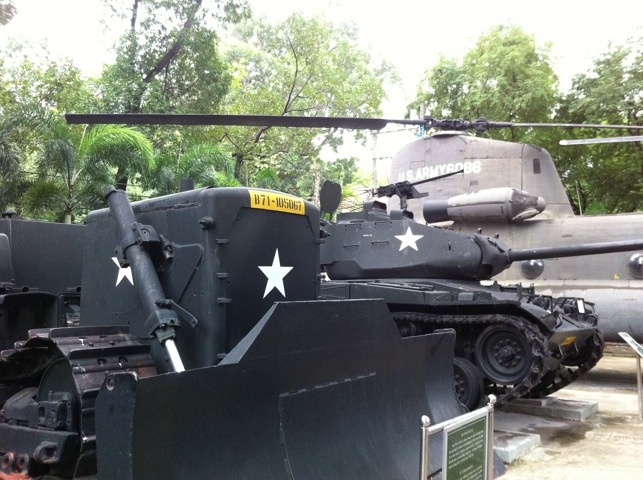
Wandering around the sights of HCMC, there are continual reminders of the war and its devastating impact on the country. It’s a little hard to separate the propaganda from reality – for example in how unified the country really is under the red flag. The communist government (who won the war and reunified the country) renamed the city after the communist party’s founder, Ho Chi Minh – but locals still prefer to use the former name, Saigon. We’re told there’s a strong north/south divide too – with the south having modernised and being the major source of investment and trade, while the north has more of the country’s ideological and cultural base.
20111114-141410.jpg

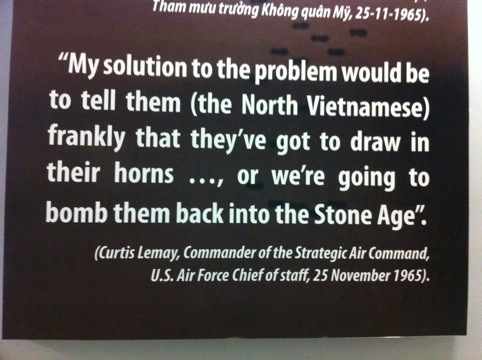
Shock and awe?

20111114-184131.jpg

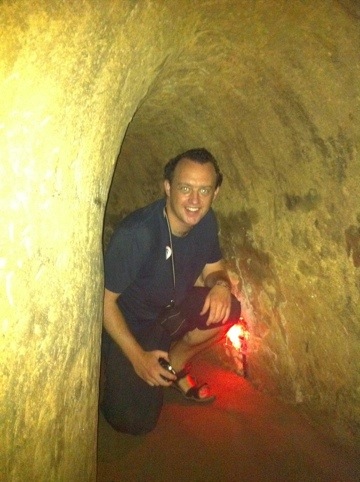
Simon in the Cu Chi tunnels


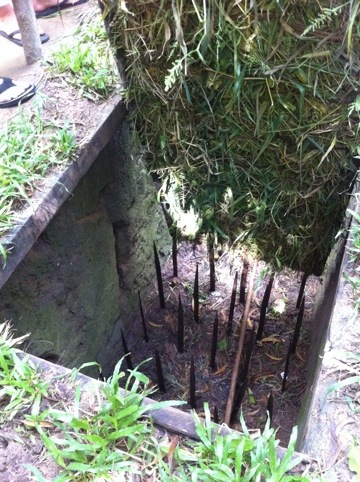
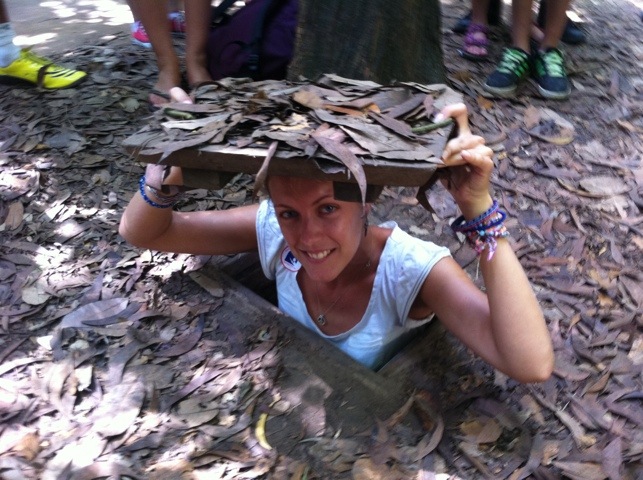
The narrative of war presented is one of communist cunning in the face of massive American military supremacy, exemplified by the tunnels at Cu Chi, just north of the city. Originally for storage but connected up in the war, locals constructed some 240km of tunnels in the clay beneath the forest, some three stories deep, with hidden entrances, and various traps to ensnare American troops. With many underground for long periods of time, there were bunkers to live in, including ingenious methods to disperse smoke from cooking fires so it rose far from the original source. We got a chance to crawl 40m through a tunnel widened for westerners (still very cramped!), and you can see Laura modelling a tiny hidden tunnel entrance. Sadly, this conquest of brain verses brawn just meant the American military machine brought in the policy of total destruction of the landscape to rout the Viet Cong, through B52 carpet bombing, and the infamous Agent Orange as a defoliant.
20111114-184346.jpg

A trap for American Soldiers


We also took in the very seventies Reunification Palace, still used for state events, and site of the defining image of the end of the war, with the two tanks that broke through the gates still present in the grounds. There was also a chance to see amazing views over the city from a newly opened skyscraper – photo at the top.
20111114-183825.jpg

Laura in the entrance to
the secret tunnel


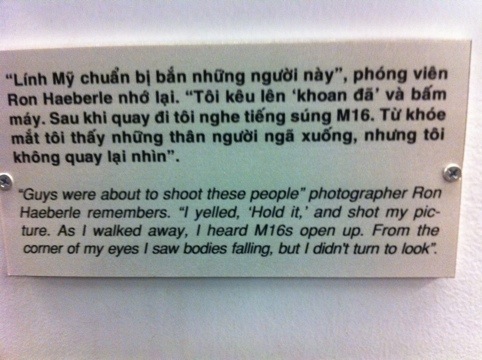
It took us two visits to get round the distressing exhibitions of the war remnants museum, which show the chilling destruction wrought by twenty years of war in photographs. These include a touching memorial to photojournalists who died exposing the truth of the conflict, with many of their final photos on display. It’s hard not to be disgusted by the barbarity of war and lack of respect for human life, especially of civilians. The photo caption pictured below from a western photographer really speaks for itself. Apparently there have now been more suicides of American troops suffering post-traumatic stress than there were American deaths during the conflict itself.
20111114-141428.jpg

One last thing – Agent Orange, or to give them them their true name, dioxins. My photojournalist friend Michael Carroll has exhibited some incredible work on the horrifying effect these poisons had on the people – of the war, but also future generations, such is the nature of chemical warfare. However shocking the imagery is (and it is), I don’t think I’d appreciated the scale of the problem. Let me give you a few numbers. It’s believed that 3 to 4 million Vietnamese have suffered illness (or death) as a result of the chemicals sprayed, and tens of thousands of troops on the side doing the spraying – American, but also other asian allies – were affected too. These chemicals were made by large western firms who still thrive today, names like Monsanto and Dow Chemical. At the end of the exhibition were some newspaper articles, including one from August 2010, entitled “At least it’s a start”, recognising the $12 million committed by the US Aid programme to start clearing up the chemical mess they left behind in dioxins at their Vietnamese military bases. I think this was generally praised as a positive move in the international press at the time, but you really have to see it in context. The same bill announced more funding for the US soldiers who were victims of dioxins, this to the tune of $13 billion. Yes, that’s million vs billion. For the sake of the millions of affected Vietnamese who have to live amid it every day, I hope it is just a start.

Simon
20111114-183455.jpg

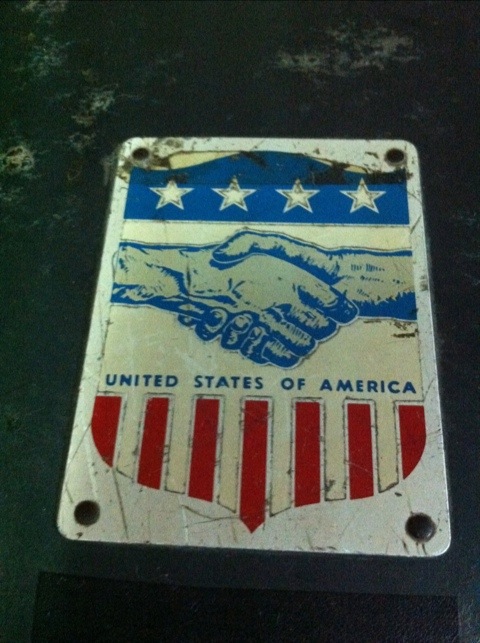
The hand of friendship?

PS. We finally worked out how to do captions. Hope you enjoy them!
Incredible India

20111113-170453.jpg

When we arrived in India at the end of September, we weren’t sure what to expect, or whether we’d enjoy it. After five amazing weeks, we can hardly believe we doubted the place – utterly inspiringly incredible, although certainly not blemish free – but who’d want something that pristine and artificial anyway?

Sitting here in a hostel in Saigon, there’s much to think back to and miss. People sleeping absolutely everywhere in the heat of the day – conventionally in the shade, but more entertainingly on tables in busy offices, on pavements, and even on the central reservation of thundering dual carriageways. Down these roads hurtle the colourful Tata lorries at breakneck speed, alongside tankers with ‘edible oil’ (for cooking?), rickety buses lurching round corners, and of course the yellow and black of rickshaws, all of which use their horns continually to announce their presence. And that’s without touching on the amazing train system, the rusting ferries, and of course houseboats – occasionally with furry stowaways.

I think above all India invades every one of your senses and tests your ability to contrast: the sight of brightly coloured turbans in the north against the white Mundu skirts that men wear in the south; the smells of rich masala sauces wafting from the kitchen and the stench of rotting rubbish; the eternal screech of the horns in the road, and the absolute silence of the desert. These contrasts seem to pervade India itself – most obviously through the difference in landscape and climate between the harsh desert of Rajasthan and the mangrove swamps of Kerala, and in the face whitening creams sold endlessly on TV while westerners are on the beach trying to go from white to brown. I think the juxtaposition goes deeper than just the surface though, to an emotional level – for India is a country whose soul is so religious and moralistic, but yet lets the horrors of caste, corruption and poverty happen – indeed religion endorsing it in the case of caste, even if there is now movement to see both caste and corruption confined to the days of the past – in the end.

Leaving India was also the end of our long journey overland from Beijing, with a flight to Vietnam for the next leg of our trip. We’ve apparently travelled 6420 miles by train (almost exactly as far as we are away from home right now), plus another 940 by road. With almost 7500 miles travelled the old fashioned way over 11 weeks, it’s sad to be taking to the air instead!

So, we bid a final farewell to a land of stunning forts, palaces and natural landscape, of friendly people, the tastiest food (which some of you back home will get to experience) and harsh weather (which hopefully you won’t!). Each of these things we’ve at times had too much of – but that doesn’t mean we won’t be back for more sometime soon! Anyone care to join us for a second lap?

Simon

Enlightening Kochi

20111111-173052.jpg

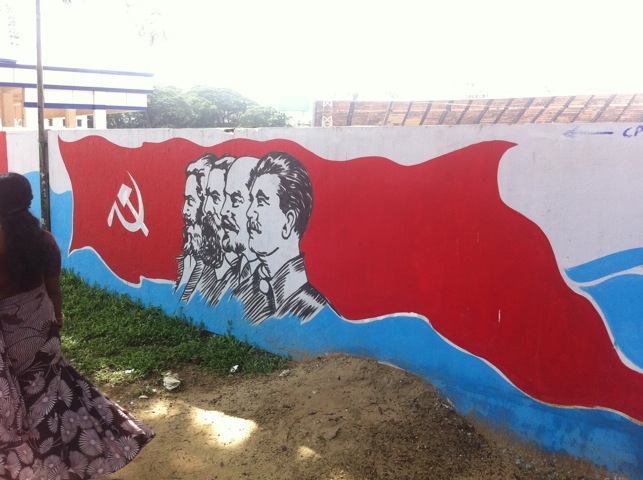
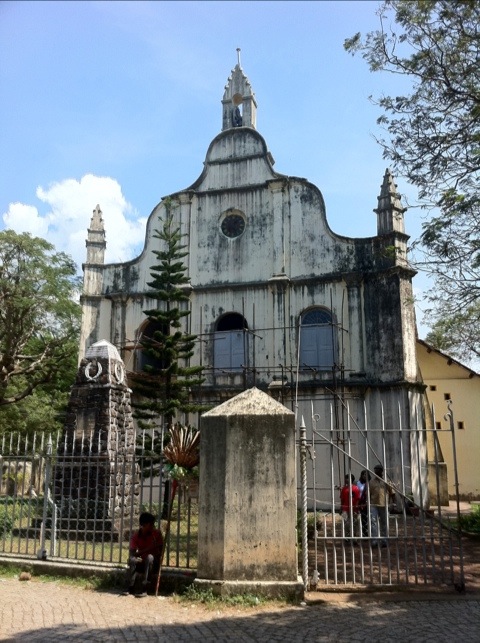
Kerala feels very different to the rest of India we’ve seen. I’ve mentioned before the lush greenery that envelops the space between the brickwork, but it became clear to us that there was something more than just this. Firstly, Kerala’s very obviously communist, with red flags and slogans painted everywhere. The government has had a good success rate with tackling poverty, which was clearly evident by the lack of street kids which have followed us around elsewhere. Secondly, Kerala’s the first place in India that we’ve seen Churches – and although only 20% define as Christian (compared to 50% Hindu), it’s certainly the most visible religion, with churches, chapels and crucifixes everywhere. Combined with the colonial buildings leftover from Portuguese and British periods of influence, this gives it a distinctly European feel. We especially appreciated it on a walking tour of Fort Cochin, between the Santa Cruz Basillica and the St Francis Church, built in 1503 and the oldest European church in the country, on the way passing the former parade ground and that classic English institution, the Members Club.
20111111-172659.jpg

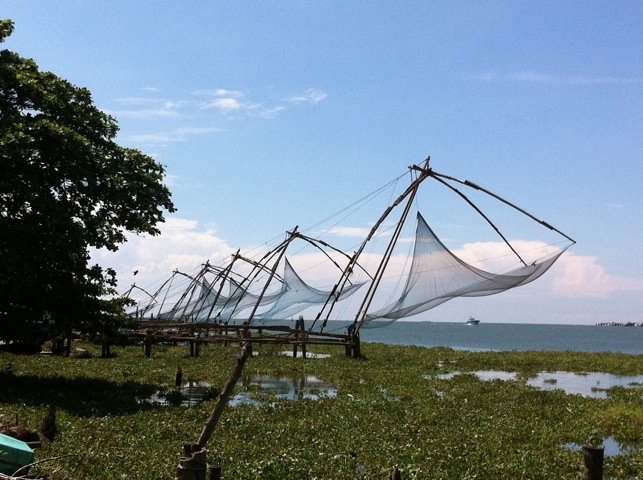
Kochi is a city spread across a clutter of both natural and manmade islands on the coast, with the tranquil Fort Cochin where we stayed a stark contrast to the container ship docks and naval air base across the water. The city is most famous for its iconic Chinese fishing nets (pictured below), which require at least four people operating them to haul in their catch. Sadly we didn’t see them in operation, but did see a lot of fishermen with poles fighting a losing battle with the floating water hyacinth that clogs up the waterways all around here.
20111111-172451.jpg

We were staying in a huge bargain room above Oy’s Restaurant, home to some of the tastiest fish curries we’ve ever eaten – a great base for our final stop in India. From here, we made what seemed like a marathon trek down to Mattancherry, home to the quarter somewhat crudely known as ‘Jew Town’, where there’s a synagogue and a suite of antique furniture shops, which were started by entrepreneurs who bought up the possessions from Jews migrating to Israel en mass in the fifties. We also found (after nearly giving up in the heat) the Dutch Palace, now a museum on the area. Kerala’s present day radical politics may have found some inspiration in the customs of the past – we learnt about the commanding role women used to play in the family, with inheritance following the female heir in stark contrast to the west. The exhibition also told us this is not the case anymore – although women still have an elevated status compared to elsewhere – with the elimination of this system a result of the ‘modernising reforms’ brought in by the British. That’s progress for you!

20111111-172745.jpg

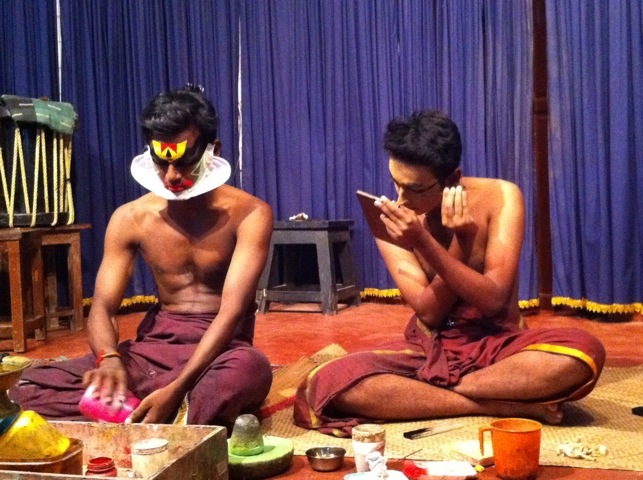
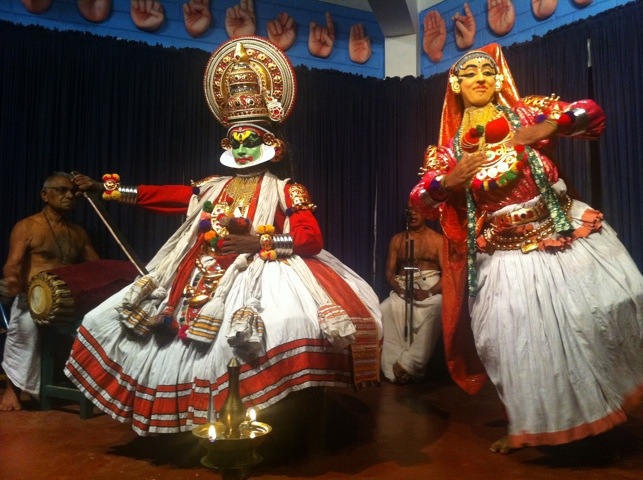
Our final night in India saw Laura don her Sari one final time, and us go to a night at the (tourist) theatre, to witness a bit of traditional Kathakali ‘story-play’ – something mentioned in ‘The God of Small Things’, if you’ve ever read it. Before the show, we got to see the make-up going on, and then an intro to how the art form works, with nine facial expressions used to express emotions – from obvious ‘love’ to the more confusing ‘pathos’ – combined with a sign language, movement on stage, and live music. Most impressive was the combination of costume and make-up on the two male performers, who were utterly transformed – and we were transfixed, even if the somewhat misogynistic story of the evil female seductress didn’t appeal to our tastes. As we left the performance for a meal to celebrate our time in India, the heavens opened, and we finished a memorable five weeks dining on tuna and prawn curries while watching the thunderstorm around us – an electric experience in more than one way, and one we’ll certainly be back to repeat in the future.
20111111-172850.jpg

Simon

PS. One quick reminder of home!

20111111-173317.jpg

The South of Kerala

20111109-141551.jpg

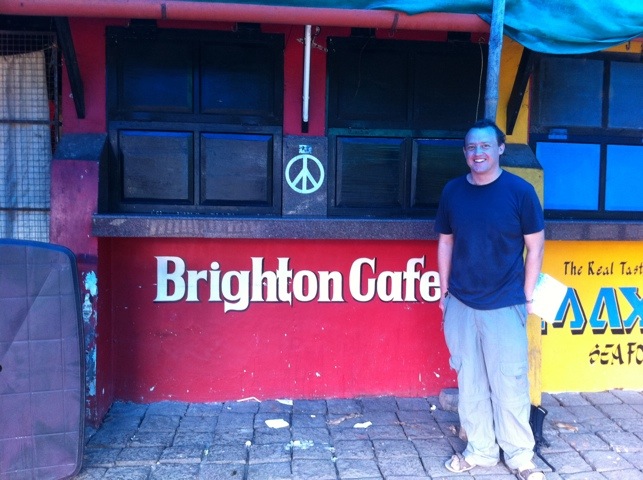
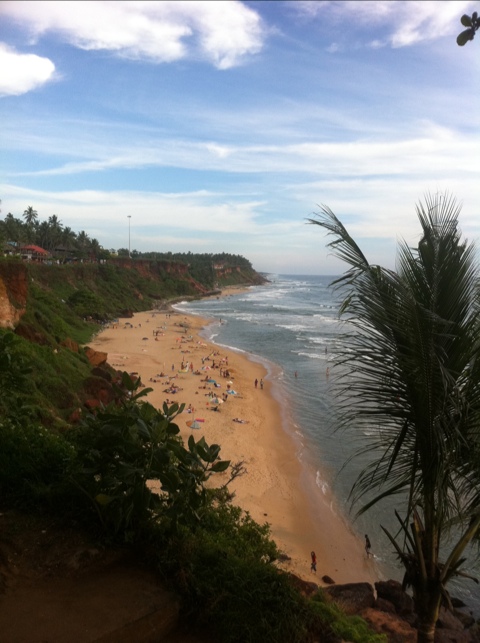
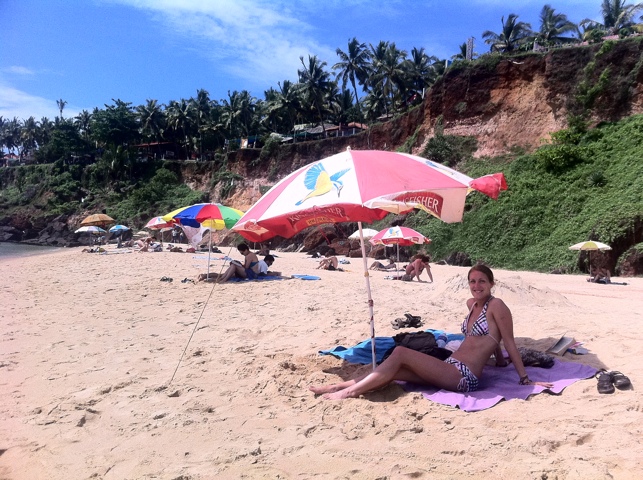
Our journey on from Alleppey took us to the beach at Varkala, a stretch of sand between bright red cliffs and the gorgeous translucent blue of the ocean. As we bounced through the network of back streets to our guesthouse, we wondered if perhaps we’d somehow got the address wrong. We were staying in South Cliff, described as being a bit quieter than the tourist hotspot of North Cliff, but I don’t think we’d quite realised that the place would be nearly deserted, and the popular cafe that was recommended closed – it not being high season. It was certainly peaceful though, with a great cliff-top perch.

Varkala’s really a town of two halves, with the main urban centre a few miles from the tourist-dominated beach. The inhabitants of the two only really seem to meet when arriving and departing – in the more conventional sense through the bus or train station, but also more spiritually at the beach, as the waters are considered holy to Hindus. Many have their ashes scattered after cremation in the waves at the south end of the water, away from the multitudes of white westerners in the next cove further north worshipping a different kind of God – the sun. As we ate breakfast one morning at a beachside cafe alongside the fishermen counting out their catch, we were able to watch the ritual of a mourning family dressed mainly in white, with a few men taking an urn to the water in a final farewell. It was strange to have this happen amid the bustle of restaurant touts trying to attract trade, and rickshaws jostling to pick up a ride – but then this close interplay of religion and everyday life is very typical of the India we’ve seen. Less pleasant was the juxtaposition between the mourners fully clothed in white and the stream of white tourists trickling past in beach wear, something we were told was an absolute no at an Indian holy site. I was surprised at quite how tolerant the locals were, particularly as we were some distance from the western enclave of North Cliff, and this was after all part of a funeral.

20111109-141537.jpg
We spent a couple of days enjoying the sun and sea of the northern beach, Laura progressively building on the bronze tan she started in Spain, and me just going straight for the traditional lobster look. Amid tasty meals of seafood, we had a great snack of a whole fresh pineapple on the beach, cut and sliced by the woman in the air in front of us, a great bite of refreshment – and entertainment!

20111109-141649.jpg
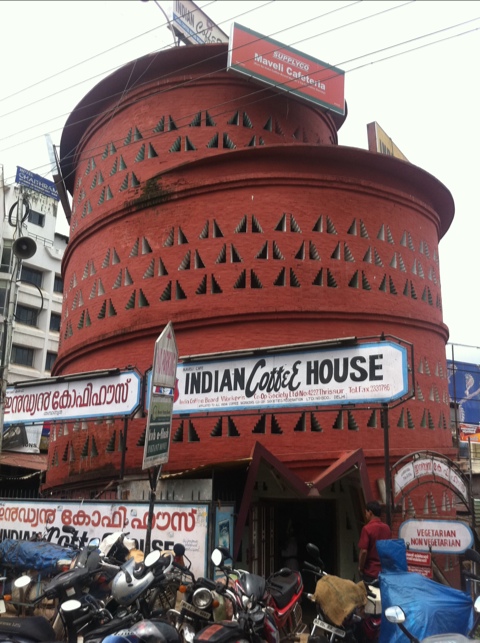
Trivandrum is the capital of Kerala, and was our next home for a couple of days, as well as the southernmost point of our trip round India, about 40 miles from the tip of the subcontinent. More importantly for us, it was a chance to try some true South Indian food – the masala dosas that Laura’s written about – as well as a brief retreat to our first western delights in weeks, in the form of pizza and pasta from a fantastic Italian restaurant in a middle class suburb. We also got to stop for a quick bite to eat at the memorably Indian Coffee House near the bus station (pictured above) – designed by a British architect living locally, with the interior one huge spiral.

20111109-141903.jpg
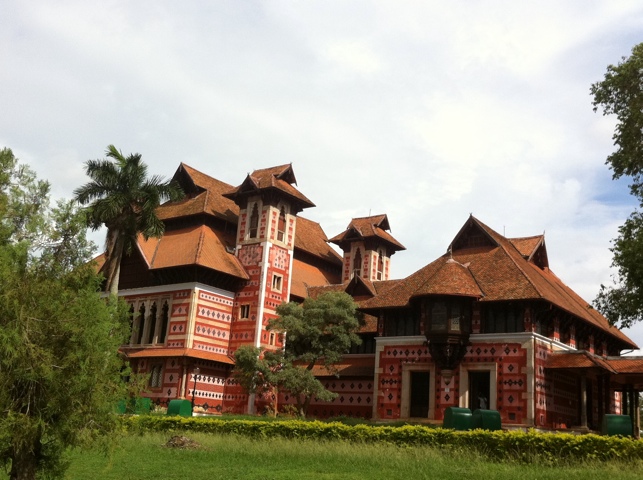
The city itself is a mix of the bustling and modern alongside some lovely green spaces and the gleaming white Secretariat building, home to the state government. A lot of the architecture in the town is typically Keralan, with wooden structures and red roofs. A highlight was the magnificent Napier Museum, a real splurge at 10Rs (15p) for the two of us. Set in a leafy green park, its interior is a world of colour, with candy stripes in yellow, blue and pink on the walls and a high wooden ceiling – not quite as garish and horrible as that sounds! The museum showcases some amazingly detailed carving, including ivory so thin it’s translucent – and a set of ornate concentric spheres that had us marvelling at how they’d been created.

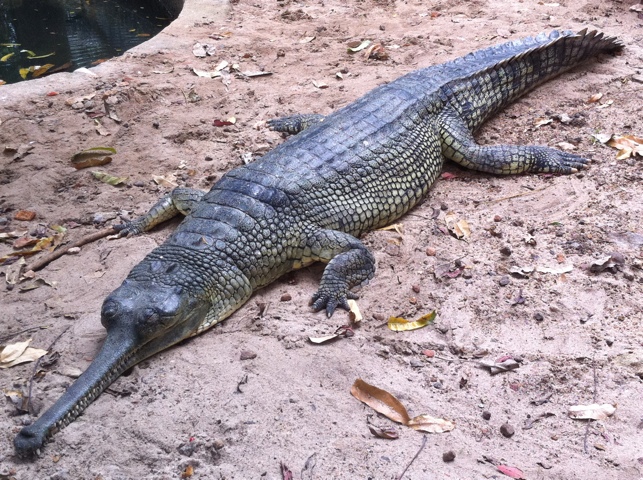
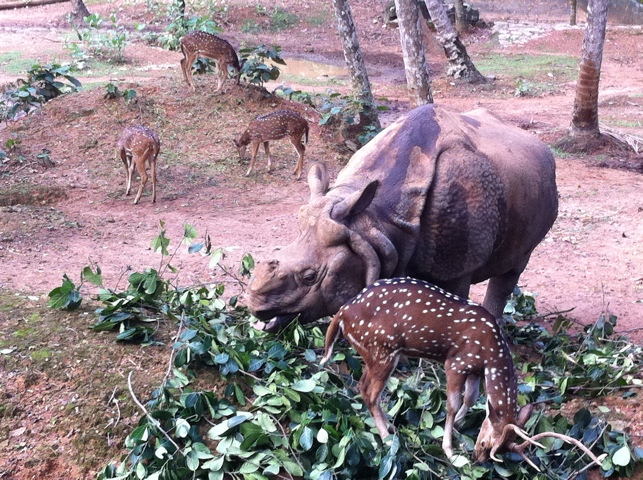
In the same parkland as the museum is the city Zoo, an unexpected success. We’ve avoided zoos so far because seeing animals in cramped cages with barely enough room to turn around is not really our thing. Fortunately, this zoo was supported by WWF (the environmental group, not the wrestlers, which would be entertaining but odd) – and so the animals were generally in large open enclosures, free to run around. Having said that, the big cats were all in cages while we were there, but we’re assured this was a temporary measure – there was a huge space nearby without any animals in. Anyway, ethics sated, we saw tigers and leopards, lions and hippos, as well as spotted deer, elephants and zebras, and alligators. Actually it was the first time we’d seen almost all of the above in India – and we can now tell you that the roar of a lion is a scary thing!

20111109-142151.jpg

20111109-142127.jpg
As a final bit of capital tourism, we popped in to the Puthe Maliga Palace, its exterior roof supports forming a line of fantastically carved wooden horses. There were also thrones on display – one made from some 35 ivory tusks (now those are elephants to be pitied), and another entirely in crystal. These were unfortunately not for us, and so we instead made our way onto the seats we’ve become accustomed to, on the train heading back north, and to our final destination in India.

Simon

The Backwaters

20111107-214044.jpg

We arrived in the southern state of Kerala to a thunderous welcome – a rainstorm. It was a bit of a shock for both of us, the first rain we’d seen in nearly a month in India and a refreshing reminder that this is the wettest state in the country.

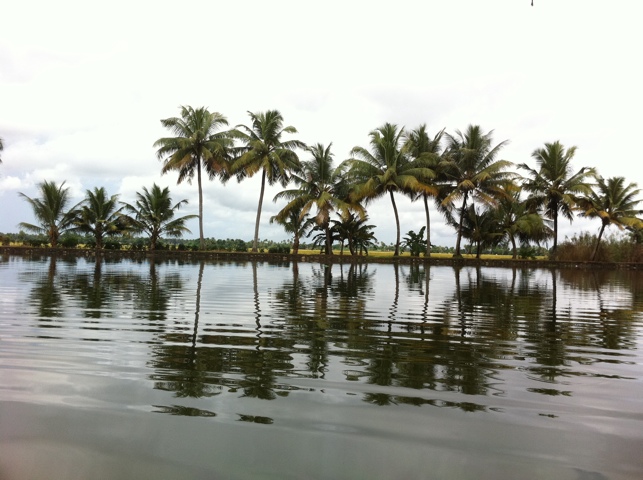
The city of Alleppey sits nestled on the west coast astride a pair of canals between the beach and the inland waterways known as the backwaters. In lush contrast to the north, and particularly the parched and desert-like Rajasthan, everything is green and it feels like a tropical paradise: palm trees silhouetted against the sky, coconuts growing above us, and huge bunches of tiny bananas on the table in our guest house, freshly picked from the garden.

It’s always a bit strange arriving at a place in the dark – and especially in the pouring rain. We spent a difficult half hour searching the dimly-lit puddle-filled streets for somewhere to eat (and succeeded), before taking a fun rickshaw journey home the way we’d come, now totally unrecognisable in the gloom of the night. It was a memorable experience, with us shouting overconfident encouragement to the driver – “just a little bit further now” – as we jolted and splashed our way in the right direction but without the faintest clue as to why we hadn’t seen our place yet. As it turned out, we’d walked A Long Way on the trip into town and hadn’t realised. Fortunately despite not being able to agree a price up front (hard to do without a clear destination!), it only cost us 40 rupees, or 60p.

We spent a couple of nights resting from our journey and staying in a cute ‘cottage’ in the back garden of a house, bordered by paddy fields and narrow waterways. We even had our own veranda from which we could sit out and admire the fireflies at night, their lights blinking on and off slowly like tiny indicators in the dark. It was amazing as the darkness closed in around us and we could steadily see more and more flashing flying lights around us, blazing erratic trails through the air. Unfortunately they were also accompanied by swarms of mosquitos who thrive on the abundant freshwater – and so we had to beat a hasty retreat into the mosquito net protection of inside.

We spent a quiet day wandering round town (much less murky in the sunlight) and made it to the beach, where a few cafes look out over the grey-yellow sand to the dilapidated old pier and the ocean beyond. The rusting black silhouette reminded me of the West Pier in Brighton, a monument to better days – and presumably a time when this place was a teeming resort.

Kerala’s main fame these days is as home to the backwaters, a set of rivers and lakes that stretch for miles inland. This is now a big tourist industry, with some 500 houseboats available to rent in Alleppey alone. It’s also something my Dad did when he visited Kerala years ago – and that we were keen to try for ourselves.

20111107-214105.jpg
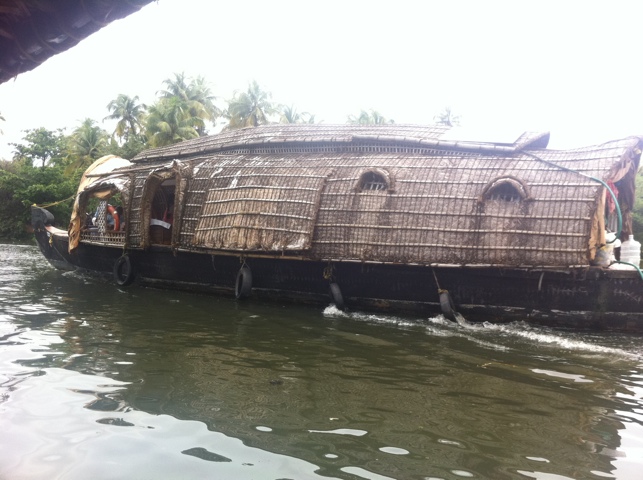
I think Laura put it best when she described the houseboats as “like wicker chairs on water” – from a distance it looks like they’re made solely from woven bamboo, with associated concerns about their seaworthiness. Fortunately, up close it becomes apparent that they have solid metal frames, even if this somewhat dilutes the aesthetic. They’re also not quite the romantic delicate boats we’d envisaged in our minds – these things are bamboo-coated juggernaughts, many with multiple en-suite double bedrooms, air conditioning, a second story, and satellite TV to cap it off. It did feel slightly like a traffic jam on the M25 as we first set off, a long tailback of boats all heading in the same direction, chugging along slowly together while spluttering smoke from their exhausts. Fortunately, we soon reached a huge lake, and the boats all scattered in different directions, peace and tranquility restored.

We’d hired a boat from our guest house which we were pleased was smaller than most, with just a twin room, bathroom, kitchen and deck under cover from which we could watch the passing scenery. Nonetheless, even at this scale it was a world apart from the narrowboats we’ve holidayed on in the UK, where a boat the same size would easily sleep 12. On those, everything – beds, seats, to toilets and showers – is in miniature to make the boat smaller. Here we had full size fittings, and space on deck for a dining table, actual wicker chairs, and also deck chairs to recline in! The boat hire also comes with a three man crew who prepared us delicious food for the three meals we ate on board. It’s no wonder this is the most expensive thing we’ve done in India.

20111107-214226.jpg
The backwaters themselves provide a serene view on waterside village life, with women washing clothes, children splashing, and men naturally sitting around chatting on the various boat jetties. I don’t however think there’s much justification to the phrase ‘virtually untouched’ – for even here there are clear signs of modernity, from the woven white plastic sacks that people have reused to give their fences more privacy to the electricity pylons and occasional sounds of kids watching the TV. As we moored up for the night in the early evening, we went for a wander through the village alongside us, meeting many smiling faces along the narrow pathways. Despite the significant tourism in the area, we were still a novelty, with parents calling out to their kids to come and watch us white people go past. We soon built up a crowd of jostling but timid youngsters around us, although sadly our interaction was limited to the ubiquitous plea from
them of “One pen, one pen?”

Our night sleeping on the water wasn’t entirely without incident – for as we found to our surprise at about 1am, we had a stowaway! We were both woken in our beds by the sound of something gnawing loudly, coming from the direction of our feet. It was loud, and we both sat there for a bit, adrenaline pumping, trying to work out what on earth it could be. A rat? A man-eating spider? An alligator?! It was with some trepidation that I picked up the water bottle and left the safety of the mosquito net cage to take on whatever was dining at our expense.

It soon became clear – but somewhat more puzzling – that the sound wasn’t coming from where our bags lay on the floor, but instead from higher up, somewhere above the door leading into the bathroom. With nothing obvious on our side, we concluded that the killer foe must instead be perched above the inside of the door, ready to pounce on whoever made the next toilet trip. As we listened carefully, I swear I could hear it sharpening its fangs for the upcoming battle. With Laura briefed on what my dying words were to be, the door was opened, to reveal the true horror of what lay inside…

Nothing! It seems that our stowaway must have been a mouse who’d made it into the inch-thick cavity between the two walls and was happily munching away at the tasty wood of the boat. The large hardboard walls were acting as a speaker cone, amplifying the sound and making it sound much larger than it really was. After enough thumps on the wall to wake half the village nearby, it finally stopped nibbling and scurried off, leaving us to try to get back to sleep in our alert state and hope it didn’t return for desert. Fortunately, it didn’t!

20111107-214214.jpg
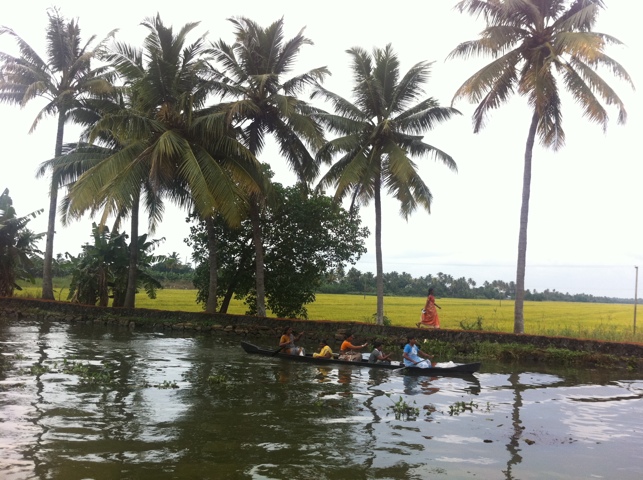
Our final day in Alleppey left us with some time to kill after departing the boat at 9am, and so we spent a tranquil couple of hours on a much smaller ‘canoe’ boat (not an actual canoe), traversing some narrower waterways and appreciating the beauty of the area from closer up than our houseboat had permitted. It was a great finish to our time on the water – a highly recommended excursion for anyone visiting the area!

Simon