Sadness and Sa Pa

20111201-142551.jpg

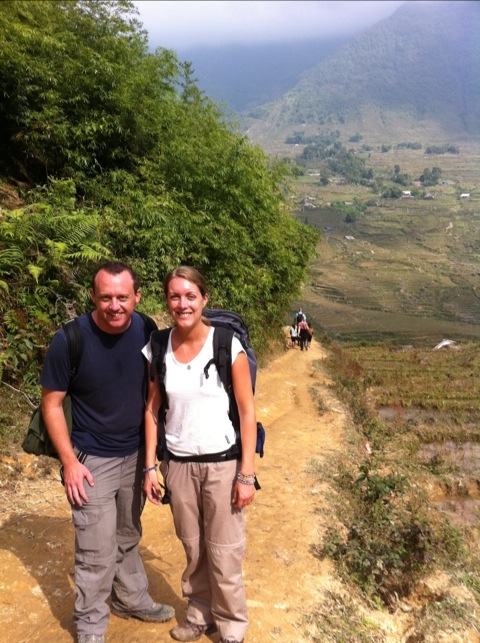
Laura and I on the trail

Just before we were about to head to Sa Pa, I got the news that my Grandad, Reginald Phillips, had passed away. He was an active man for a ninety year old, having swum daily until recently, and his antics sometimes made us wonder if he was actually fifty years younger! He’s been following our travels from home, having travelled extensively in his life – during the war in the Merchant Navy, and then later on a couple of round-the-world cruises.

Hearing the sad news has made me think of the many stories he told us grandchildren of his visits to far-flung places: of changing ships in New Zealand to find his prior vessel sunk a week later; of sitting on the same bus his brother had done a week before on the other side of the world and being recognised and taken in by friends; and of the delights of walking in the Catskill Mountains in New York State on shore leave during the war. As we continue our own adventure, I’ll be thinking of him on his and the message of friendship he spread through his involvement with the YMCA and throughout the world.

Sa Pa is a hill station set in the mountains in Vietnam’s far north-west, near the border with China. It’s famed as the cultural crossing point of many of the indigenous minority peoples of the northern highlands, and the best way to get a taste of what life is like for those still living a very traditional existence.

For us, Sa Pa was also the cause of some trepidation, as our train was due into the nearby town of Lao Cai at six in the morning, and we’d been told to expect scammers on the one hour minibus journey up the mountain. It’s the same trick of overcharging we’ve heard elsewhere – either charging a ridiculous rate to the unsuspecting foreigner, or quoting a reasonable price and then on arrival revealing it to be US dollars and not Vietnamese Dong – hence inflating it by a factor of twenty. Armed with the right price for the journey (50,000 vnd), we were relieved to immediately find an honest driver and soon be on our way. I think it says something for expectations that after this apprehensive start, we fell in love with Sa Pa, and left sad not to have been here longer.
20111201-142828.jpg

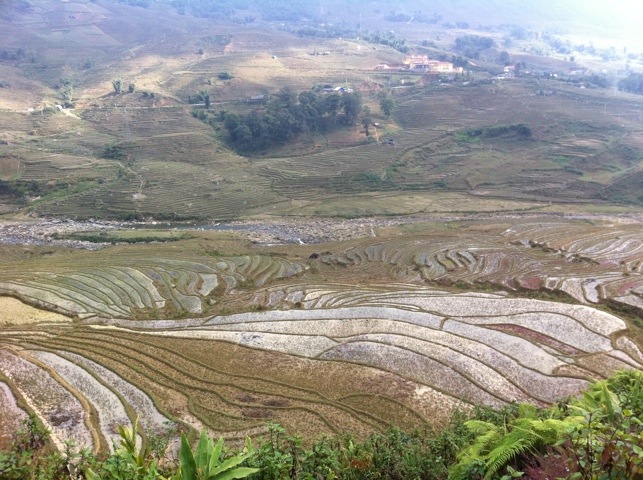
The rice paddies across the valley

The cool mountain air, calm streets and bright tribal costumes for me quickly brought back memories of time my friend Roland and I spent in Huaraz in Peru, trekking in the Andes. As a quick respite from the night’s journey, we settled in to breakfast at a brilliant place Laura honed in on – appropriately called Baguettes and Chocolate, and then struck out for the day.

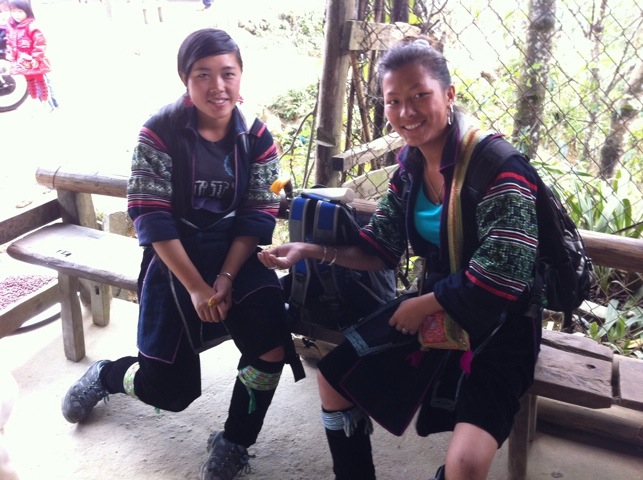
Women from the local minority villages supplement their income by being guides for tourists, and we found our guide Mai through her friend Ying (http://hmongtour.wordpress.com). The different tribes are recognised by their colourful dress, with the Black Hmong wearing dark blue tunics embroidered in greens and red, black headbands and velvety socks around their ankles. The headgear differs greatly between the different minorities, with some
wearing stark bright red headpieces and others in shades of green. Although her family still lives in the valley, Mai’s life has recently taken a more westernised turn, as she fell in love with a trekker from Belgium and has just spent a couple of months in Brussels with her fiancé – it sounded like it was quite a contrast to the life she’d led here! She’s hoping to get married next year and move away permanently, but for the time being is in Sa Pa and was being continually welcomed back by various friends we bumped into along the way.
20111201-142640.jpg

Our hosts, Ying and Mai in their Black Hmong clothes

As we walked down into the valley beneath Sa Pa, we were treated with a vista immediately reminiscent of Nepal. Stretching into the far distance were the familiar etched contours of thousands of rice paddies, each a tiny glimmering reflection of the bright blue sky, surrounded by an edge of greeny-brown. Up close, the mirrored sky in the paddies is punctuated by barren rice stems, harvested a few months ago and now left to wither in the water, creating an eerie silhouette.

Between the paddies are a web of streams and small waterfalls feeding them. Shade is provided by towering thickets of giant bamboo, which in places have been felled and cut in half to redirect the water along makeshift aqueducts. These drinking water streams end up outside houses, providing a continually running water supply that we’ve also seen while trekking elsewhere. The houses themselves are simple constructions of woven bamboo with either a bamboo or corrigated iron roof, and an indoor cooking area over an open fire.
20111201-142507.jpg

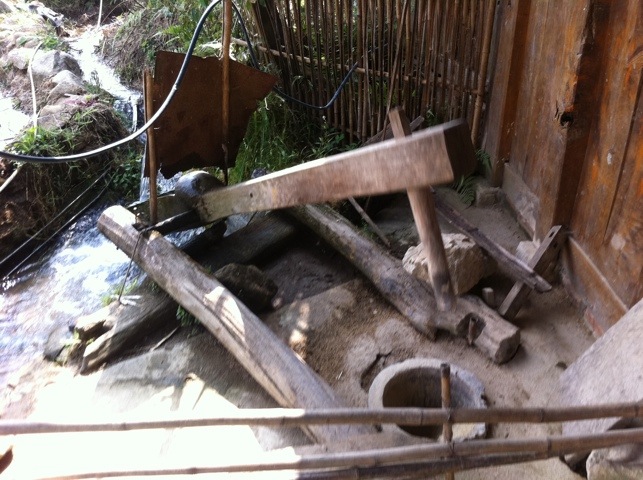
De-husking rice using water power

Mai showed us how the villages go about living off the land, pointing out the corn husks drying for seed next season, and the indigo plants they use to dye their clothes. Laura had a go at dyeing and for half a day her hands turned green making her look like the incredible hulk! They use hemp for their clothes – something which has never really taken off in the west due to the stigma from marijuana in spite of its relative strength over cotton. I was also intrigued to see how they’d made use of water power to de-husk their rice, with the flowing water periodically tipping a bamboo pole, lifting a stone which then dropped into a bowl to separate out the rice.
20111201-142930.jpg

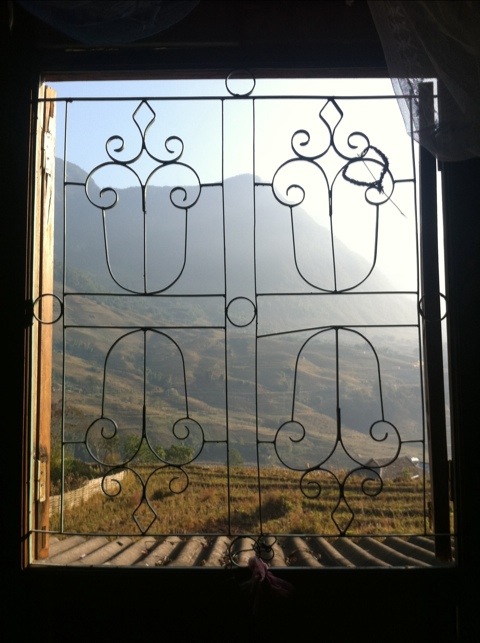
The view from our homestay window


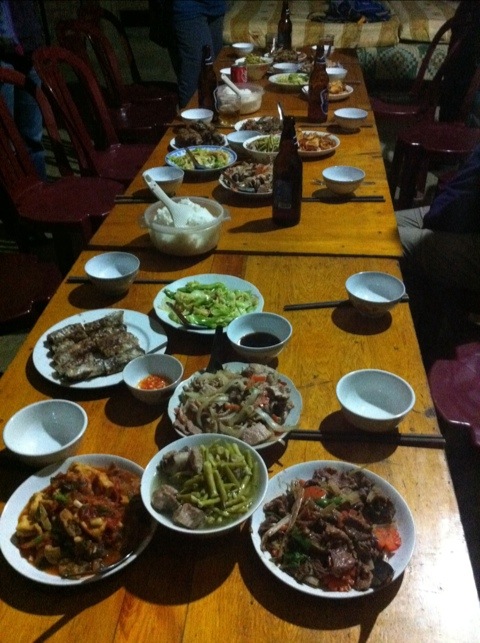
At night we slept in a ‘homestay’, essentially a mattress on the floor of a building adjoining the family home. Best of all, this meant that as the darkness closed in outside, we were able to curl up around the communal fire and watch as food was prepared. It seemed our hosts were trying to compete with the scenery outside, as mountains of flavoursome goodness were crafted before us – which we then gleefully got to eat along with the family and the handful other westerners staying there. There was about three times too much food, which they then ate for breakfast the next day.
20111201-142848.jpg

Dinner laid out for all to eat!


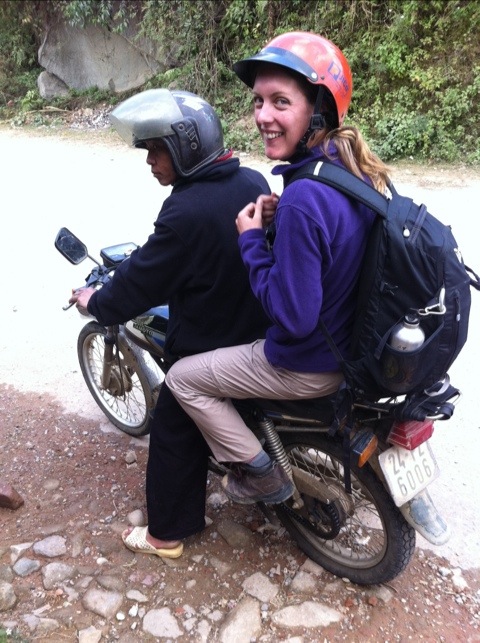
Our route out of the valley was a little speedier than our arrival; we each hopped on the back of a motorbike for an exhilarating journey back up to the town, a thrilling ride and certainly more fun than taking the bus!
20111201-142629.jpg

Laura about to bike back to Sa Pa


As we’d been walking into one of the villages this morning, Mai had introduced us to some of her friends who were returning with empty baskets having delivered an offering to a house up the hillside. We could hear the chatter of a celebration as we approached, and she told us it was a wake to mark the anniversary of the death of a woman three years ago. The celebration made me think of my Grandad, and how he really fully lived his life, and how much he loved us grandchildren. As we later sped through the valley on our motorbikes, I thought of the many journeys he’s been on, and how he’d smile to hear of what we were up to now, sailing through beautiful hills in the sunshine – and living out our dreams. I hope he’s able to do the same where he is now.

Simon
Descending dragons and incredible islands

20111124-220557.jpg

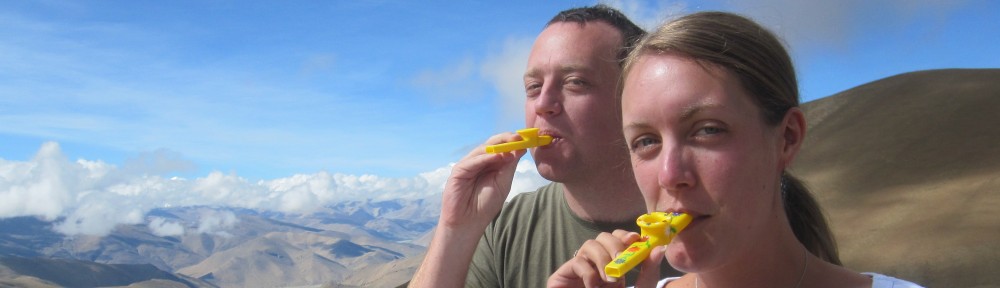
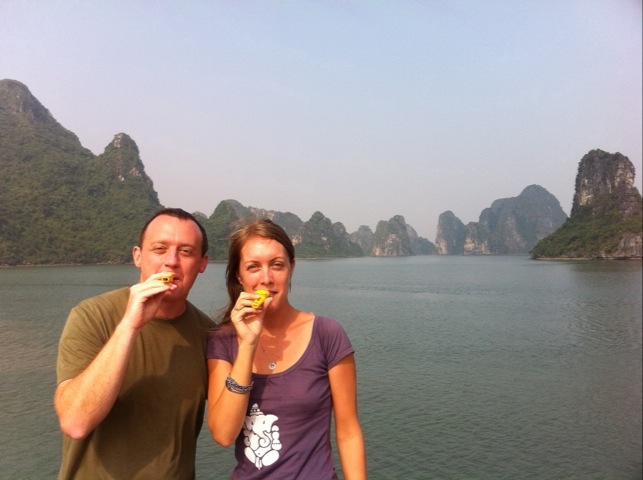
The obligatory Kazoo photo!


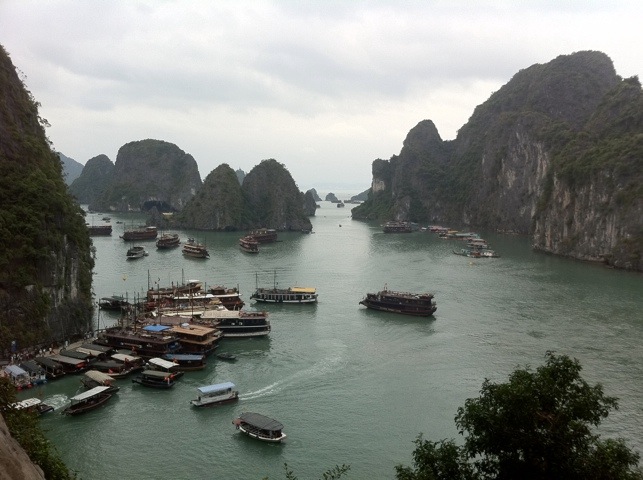
Ha Long means ‘descending dragon’ in Vietnamese. Gazing out across the green South China Sea* at the silhouettes of thousands of islands rising steeply from the water, its easy to think you could be in ancient land of dragons and fairytales.

20111124-220800.jpg

View from the cave

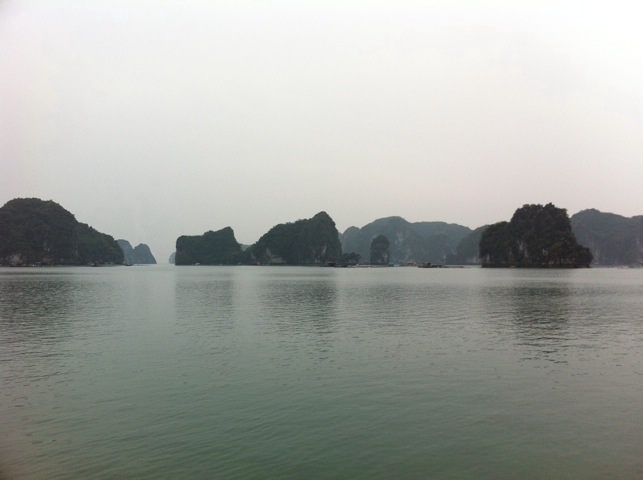
Without a doubt, the bay is one of the most stunning natural vistas I’ve ever seen. We spent much of our time gawping at the soaring greenery-topped rocks from which nature has cut dark caves and yellow beach coves over millions of years. The vast majority of the 2000-odd islands truly meet the definition of tropical, uninhabited and oozing lush green vegetation out of every crack in their craggy slate-grey core. I think the most surprising thing is that they rise so steeply out of the water, like the grey fingers of some unseen giant’s hand beneath the surface. Interestingly, the shape of the islands isn’t caused by the waves – at water level, you can see where the cliffs have been eroded by the ebb and flow of the tide, causing only a small overhang of a few metres – not the sheer vertical sides that define them. These instead have been formed from the geology of the region which left a thick layer of limestone deposits of hard and soft rock. The soft stuff has since been eroded by the wet climate, leaving the harder bits to form islands.
20111124-220837.jpg

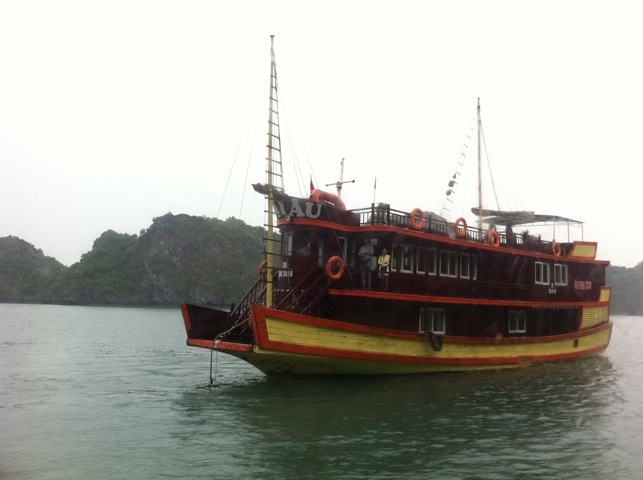
Our junk, the Golden Star

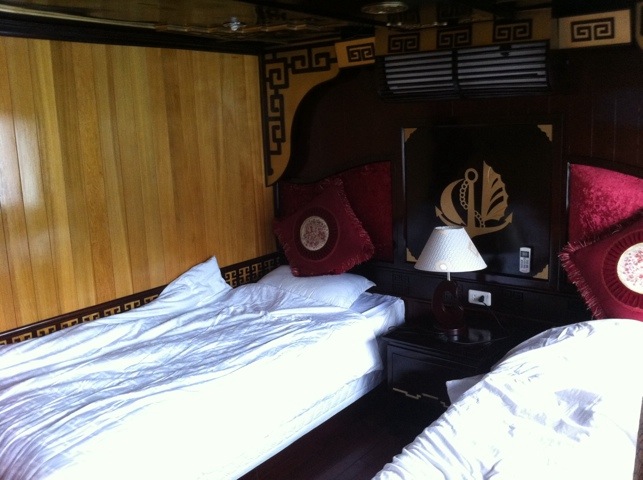
We’d joined a tour from Hanoi to Ha Long Bay for three days and two nights to take in the scenery, staying the first night on our boat in a fantastic cabin, and the second in a hotel on Cat Ba Island, the nicest we’ve been to in the three months we’ve travelled. We spent quite a while reading reviews before settling on ODC Travel as our tour operator. This is not a place to scrimp on spending; with attitudes to safety not what they are back home, some of the boats are of questionable seaworthiness – earlier this year a tourist junk sank in the bay in calm seas, claiming the lives of 12 people on board. I’m sure you’ll be relieved to know our boat was impeccably well maintained and after taking the trip, we’d recommend it to anyone.

20111124-221251.jpg

Our cabin on the boat

Our tour took in a cave, which was deep and impressive – although overrun by hundreds of other tourists also visiting it. It was one of the few times we’ve really experienced queueing here in Asia, with a tailback up the steps to the cave. We also had some adventure activities on the schedule, where we got to try our hands at kayaking, and, I guess, our legs at cycling.

20111124-221542.jpg

We kayaked to the island sticking straight up just to the right of the centre

The diversity in activity was matched by a similar range in weather; overcast on the first day, rain on the second, and then finally a blast of sun as we headed home to the mainland at the end, giving us the chance for a quick swim in the sea off the back of the boat. Cycling between paddy fields in the midst of the downpour was certainly an experience, after which we were sufficiently damp that a second kayaking outing in the rain seemed like an obvious choice. The others in our group weren’t quite so sure, choosing to remain inside the warm and dry of the boat, but we were pleased with ourselves when we returned victorious from our voyage to an interesting looking outcrop in the distance – photo above.

20111124-221128.jpg

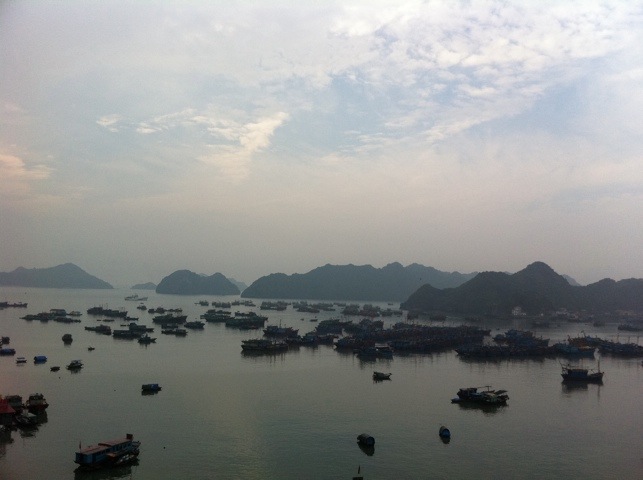
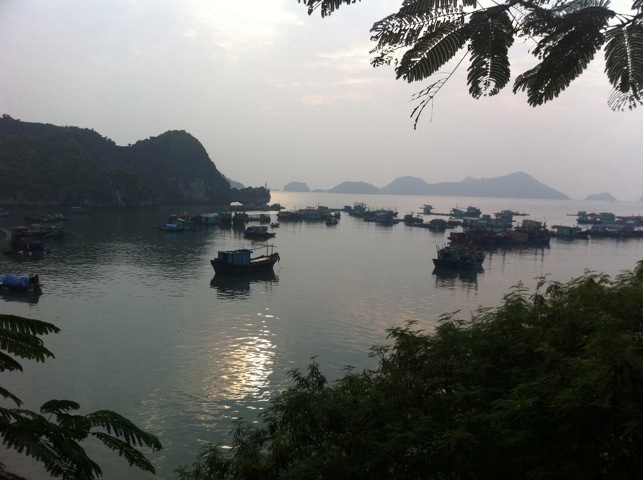
The bay at Cat Ba Town

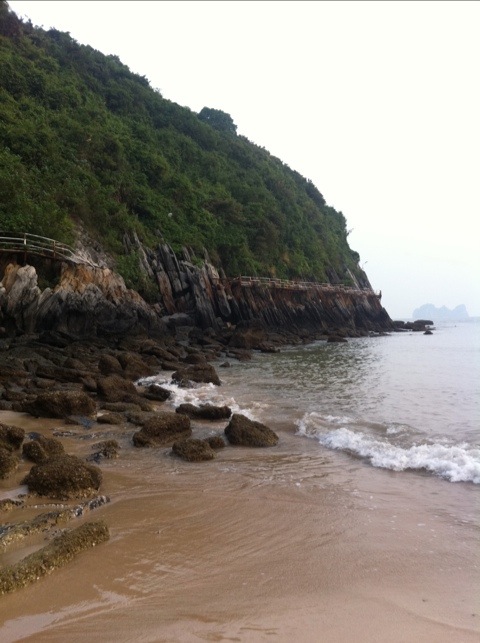
Our night on Cat Ba Island was a fun break from the water. I might be pushing things here, but it felt a bit like a tropical version of the Isle of Wight. Ok, so the Isle of Wight doesn’t have a UNESCO protected nature reserve (although The Needles are quite fun), but in season, it does have boatloads of tourists (fortunately we were out of season), and a small road network which slightly undermines the charm of the place. There’s also a big fishing industry here, the bay in front of Cat Ba Town full of identikit trawlers in a uniform of blue and red, which at night resemble more of an eighties disco as they all turn on their neon florescent lights with which they work by. The island also has a splash of sparkling white beaches, strung together by a lovely cliff path running round a peninsula. As you can see in the photo below, we were entertained to see the route ahead somewhat impassible where it once continued round to the third beach – after debating our rock climbing skills, we decided to give a miss.

20111124-221059.jpg

The less well maintained walkway

The only sad thing about the trip was that the weather wasn’t better while we were there, as it wasn’t warm enough to spend the afternoon on the sand, and the spectacular sunrises and sunsets we’d been promised in the bay were hidden by cloud. However, invigorated by exercise, sea air and natural beauty, we feel all set to return to do battle with the clamour of Hanoi, taking a break from the sea again until we get to down to Cambodia in time for Christmas.

Simon

*Unsurprisingly, they don’t call it
that here!

20111124-221042.jpg

The view from the cliff walkway

Hostility in Hanoi

20111127-163137.jpg

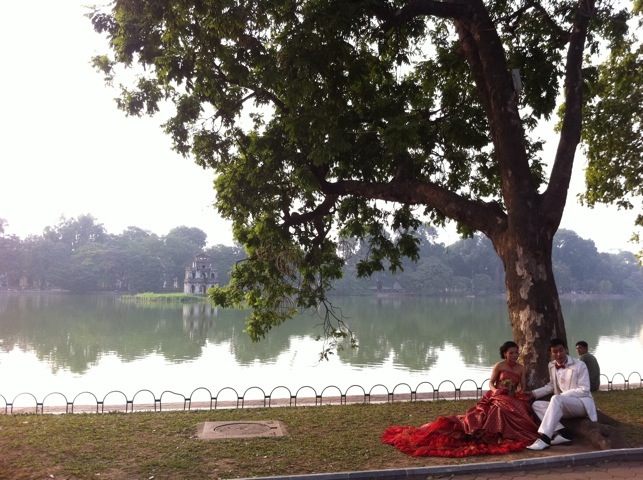
A couple posing for wedding photos at the lake

With us weary from a night on the sleeper train, being ripped off by a taxi driver with an overclocked meter didn’t exactly endear us to Hanoi. Our hostility hardly improved when we made it to the hotel on foot to find they didn’t have the twin room we’d reserved at the price we’d agreed. Fortunately, a bit of negotiation and a handshake later, we were settled into a ‘delux’ room within our budget, refreshed and set to take on the city, with even HBO on the television as a home comfort to return to at night.

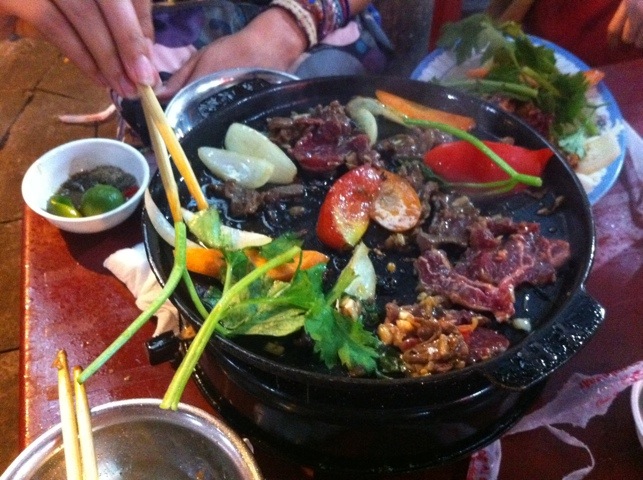
The old quarter of the city is a confusing warren of congested streets filled with honking motorbikes, hostels with misleading names, and 101 places all claiming to be the Sinh Cafe, the most popular travel agent in Vietnam. Alongside the motorbikes, the streets are crammed full of stalls with tiny stools selling beer, and sometimes also offering self-cook BBQs (tasty, but watch the hot oil splashing!). There are also hostels and hotels everywhere – this is traveller central, if our being scammed on the journey in hadn’t already confirmed it.

20111127-163356.jpg

Our BBQ dinner


We orientated ourselves in the typical way – by finding a geocache! It gave us a great tour of the lake at the heart of town, and some entertaining snaps of people posing for their wedding photos with the lake as a backdrop. We played ‘guess the genuine couple’; plenty of them seemed to be posing for magazine photoshoots instead. It also gave us a chance to take in the Cathedral, a huge old building with lovely stained glass, bringing back memories of churches back home.

20111127-163221.jpg

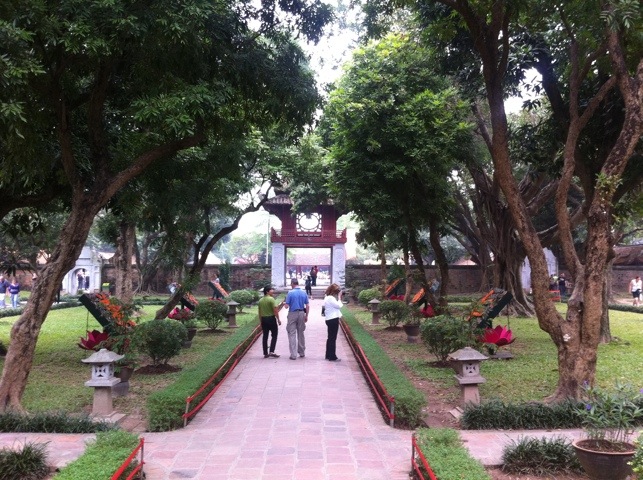
Symmetry at the Temple of Literature


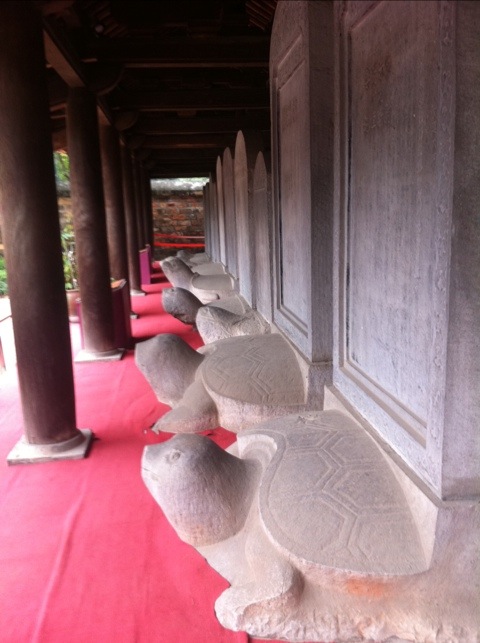
The city is home to Vietnam’s ‘Temple of Literature’, a homage to academia and the country’s first university – the use of word ‘temple’ shows just how ubiquitous worship is as part of society, much like we found in India. The temple was constructed to following Confucius’ teachings (imported from China), and the Emperor made it the place to sit entrance exams to become a mandarin and join the civil service. In some years, up to 15,000 applied, but only five passed the final royal exam, set by the emperor himself. In an entertaining challenge which perhaps should be adopted back home, none of the letters in the Emperor’s name could be used when giving answers, as to do so would be disrespectful. Fortunately his name was usually quite short; ‘Her Royal Highness Queen Elizabeth Windsor’ might prove more of an obstacle!

20111127-163202.jpg

Stelae with inscriptions of all those who passed the Royal Exam


While in town, we also picked up our visas for Laos (they were brilliantly efficient), and while waiting for them we did our first puzzle geocache, which involved us sitting next to a noisy and busy road by a lake desperately working out how to get some cats, dogs and a lion across a river without catastrophe ensuing. We succeeded, they survived, and the cache was a great distraction!

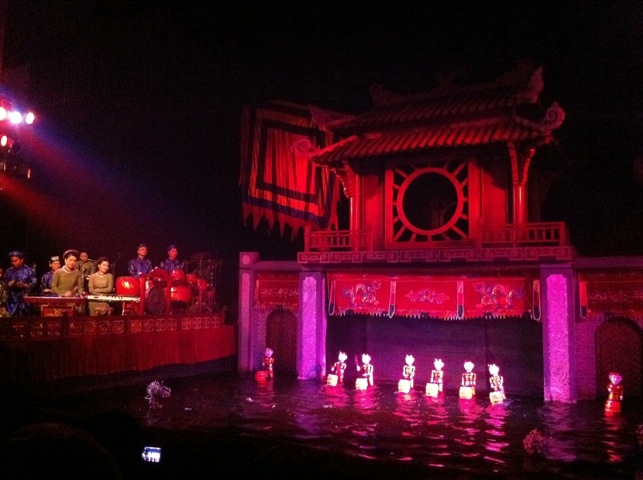
Our final night saw us take in high culture, in the form of Water Puppets. This traditional artform originated from villagers putting on performances during the seasonal flooding; it’s now descended to be just a pure tourist attraction, but was entertaining nonetheless, with the puppetmasters behind a bamboo screen, controlling their actors through poles and wires hidden underwater. Most memorable was the range of motions they were able to achieve, with puppets spinning, dragons diving under water and spitting water, and flaming processions of much of the cast along a hidden track.

20111127-163324.jpg

Water puppets, with the live band on the left


Finally, as we were packing to leave for Ha Long Bay, we learnt a lesson that I never thought I’d have to acknowledge – follow your sister’s advice! We’d been staying at the Hanoi Emperor Hotel, which was slightly cheaper than the place Alison had recommended (and hence within our budget). However, as we received back our laundry things began to unravel, as it was dirtier than it had been when we sent it off. When we refused to pay, they were less than friendly let alone apologetic, resulting in us departing at 7am the next morning amid some raised voices and charming language, and a certainty for us that we will instead go to the Little Hanoi Hostel. Thanks Alison!

Simon

The hues of Huế

20111123-181303.jpg

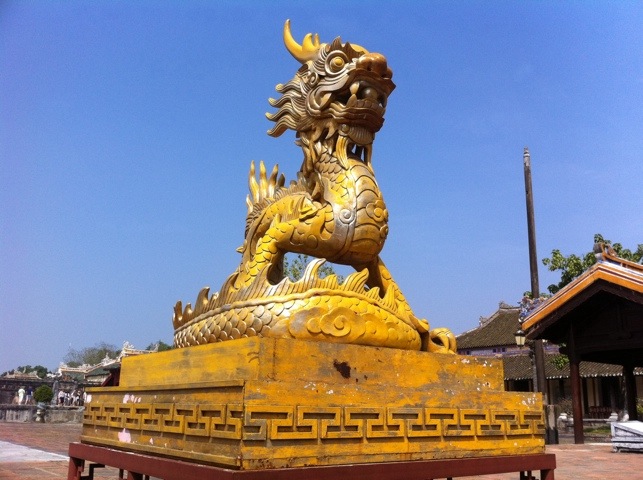
A golden kylin guarding the Imperial City

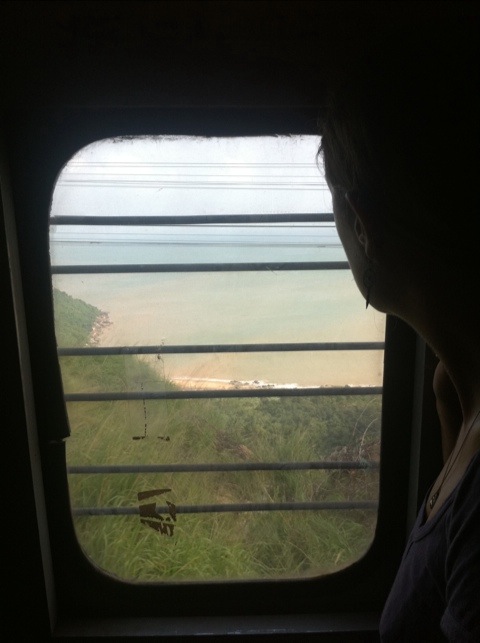
We’ve had quite a varied experience of actually travelling in Vietnam so far. Trains are very good. We’ve now been in ‘hard’ and ‘soft’ sleepers (the only difference is really 6 vs 4 berths) but they’re pretty luxurious compared to India, with compartment doors – and even a duvet! The only thing I miss is the brilliant organisation of Indian Railways, with its printed seating reservation charts posted on the outside of the train and the sheer scale of the operation. These feel like a kids toy in comparison! The views however have been fantastic, with a stunning costal journey up from Hoi An alongside stark cliff edges and the shimmering sands of deserted beaches.

20111123-181053.jpg

View from the train between Hoi An and Huế

We’ve also now taken motorbikes for the first time, in the form of a slightly surprising station pickup from our latest guest house. I think it’s fair to say we were somewhat skeptical about our chances of survival when we trudged off the train with our pile of backpacks and day bags (and a large bundle of clothing to post back home) to find a couple of guys on scooters waiting for us. It turns out that it works quite well with a backpack jammed in the footwell and us clinging on, seated behind the driver (fear not, we had helmets!). Oh, and it turns out you don’t need to wrap your arms around the guy (unless of course you want to) – there are handles by the seat for that! Next time I will avoid also having a bag of clothes though, which provided an entertaining balancing challenge, all the more exciting given this was my first motorbike journey since I was in Brazil 10 years ago!

It’s a bit strange the absence of rickshaws here – we became so used to them in India that the idea of stepping into an A/C taxi seems, well, foreign (but I guess that’s fitting!) Since they’re pretty much the only convenient way of going longer distances in the cities, we’ve had to adapt – but although much cheaper than the UK, they’re still a painful expense, so we’ve been using our feet wherever we can.

We’ve also dabbled in the local buses, which are famously exploitative of tourists. For our journey from Da Nang to Hoi An, we knew the fare should be 15,000 VND (50p) – which is what the locals were handing over – but the ticket boy insisted on us paying 40,000, threatening to kick us off the bus if we didn’t pay when we stood firm. We think this is in part because he’d already conned some other tourists on board and would have to refund them too. Reluctantly (but still cheaper than a taxi), we paid up. On the journey back, we paid the correct fare, showing that at least some of the fare collectors are honest.

Whichever way we’ve travelled, the view out of the window has been very different to India. The dusty plains and palm trees have been supplanted by acres of small plots of land, with rolling green mountains behind. Oddly, dotted amid the vegetation everywhere in the countryside are lots of graves – presumably family members buried on their family vegetable plot? It was even eerier to see many of these underwater in the flooding near Hoi An – I guess that’s just a side to the monsoon you don’t think of.

20111123-181846.jpg

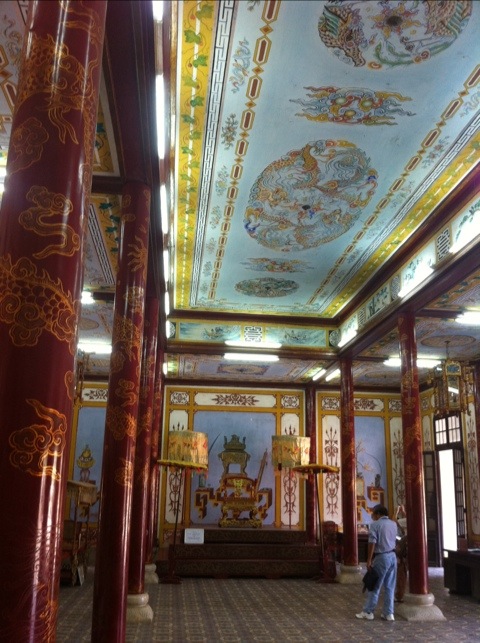
Inside a temple in the Imperial City

As we’ve gone on, at times its been hard to remember we’re in Vietnam and not China. Many people look ethnically Chinese, and their language has a Chinese accent to it; the detail of the temples and pagodas are also in the vibrant hues of reds and glistening golds we recognise, and there’s definately a fair few blue dragons on the rooftops. The saving grace is that the script uses the Latin alphabet, and so we’re slowly beginning to recognise and pronounce some of the words, a real challenge for us in Beijing.

20111123-181826.jpg

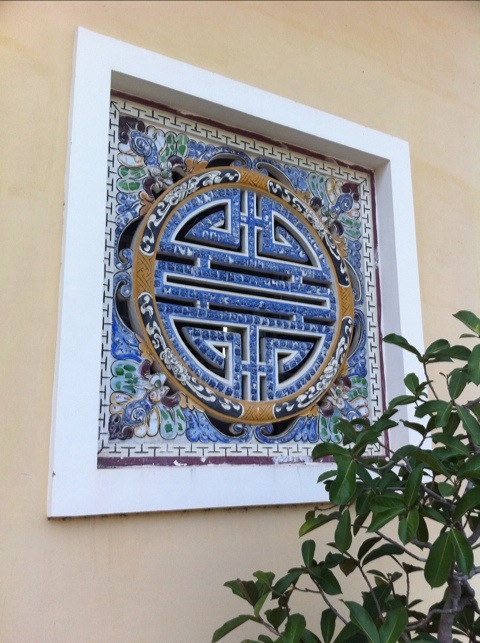
A colourful ceramic-embedded emblem in the Citadel

The guide book optimistically says Hue has “stood aside from the current economic frenzy … A small peaceful city, full of lakes, canals and lush vegetation, all celebrated in countless romantic outpourings by its much esteemed poetic fraternity.” If the world of work taught me one thing, it’s to manage expectations – and ours were truly set by this description. So it came as somewhat of a disappointment to find a noisy, traffic ridden strip (euphemistically named the ‘South Bank’), surrounded by high rise hotels and a view across the river to huge neon adverts for the local beer company. Perhaps the literati have been drinking too much of that stuff! As we found, there is a nice part to the city – but it’s a stretch to say the place as a whole is peaceful, and it certainly isn’t small either.

20111123-181632.jpg

The Imperial City in the Citadel

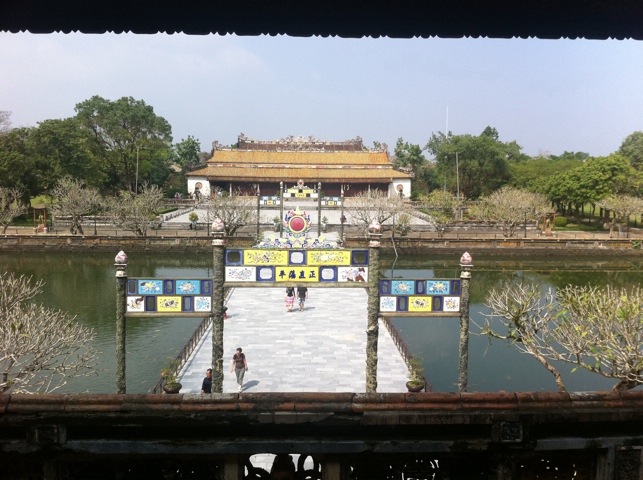
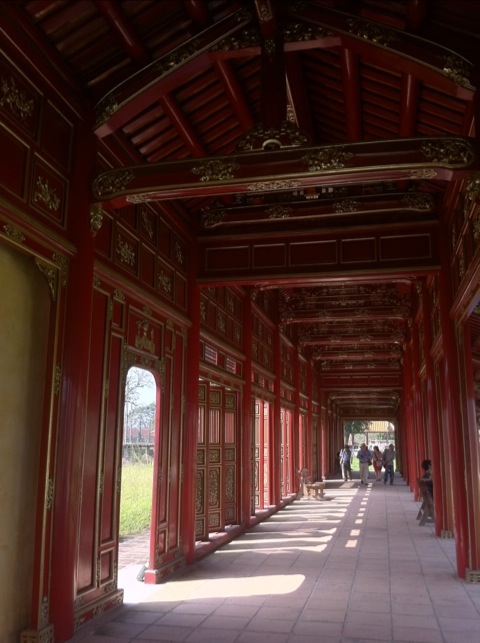
Hue is famous for its citadel, whose 11km of walls are still intact, along with a decent, wide moat to keep intruders out. Again there are strong echoes of Beijing here, with the Imperial City strikingly similar to its Forbidden City, with a nested Forbidden Purple City for the emperor and his concubines, and the red flag flying in front similarly positioned to where Tienanmen Square would be with its portrait of Mao. This part of the city is indeed lovely – although partly destroyed by bombing in the war, what remains is a mixture of quiet and ramshackle gardens intermingled with wonderfully restored buildings and stunning ornamentation. These include an intricately patterned theatre; majestic corridors of teak beams with bright red and gold decoration; yellow dragons gleaming in the sun; and stunning blue and white decorative emblems made from pieces of embedded ceramics. Hidden among these were also a couple of Geocaches which we delighted in finding – one with a huge frog living next to it!


20111123-181931.jpg

A bright corridor near the geocache

The citadel also has an entertaining ‘digital reconstruction’ of what it once looked like, funded by aid from South Korea (and heavily sponsored by Samsung). It was interesting to see how the jigsaw of ruins previously fitted together, but the highlight that made me laugh out loud was how the video ended with a computer rendered cut scene of the emperor sitting before the imperial court with his mandarins bowing before him. Such was the style of the digital graphics, the panning camerawork, and the massed drumming in the background, it could have come straight from the pre-fight intro sequence to any number of ‘beat-em-up’ computer games, say Tekken. I was just expecting a “3-2-1 fight” message on screen when the closing credits came up!

20111123-182139.jpg

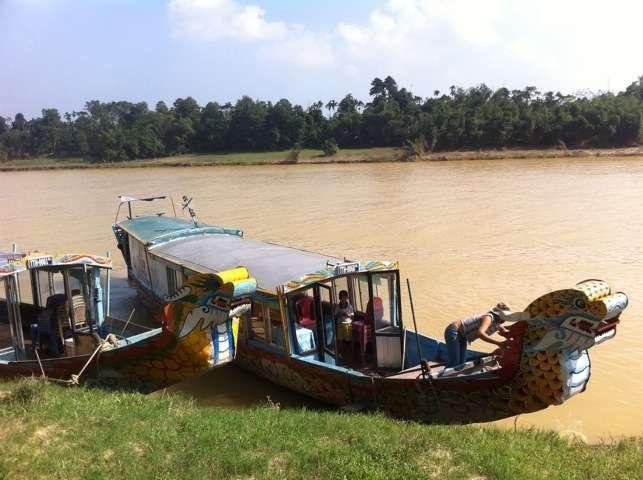
Our boat on the perfume river (on the right)


Other than food (which I’ll leave to
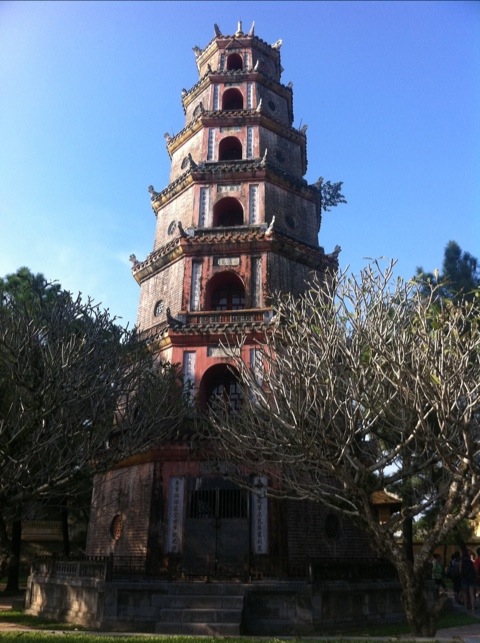
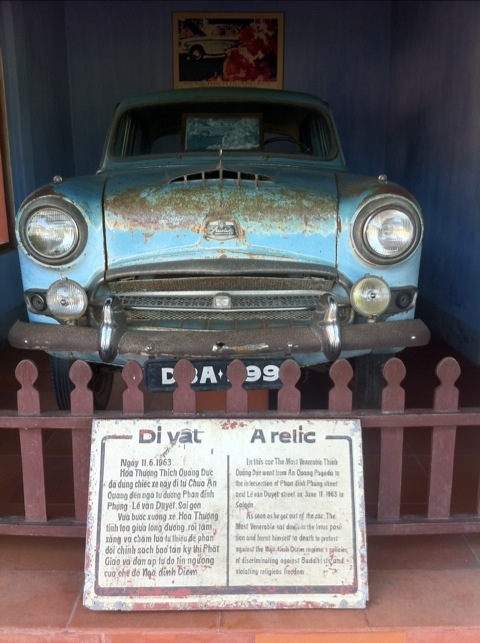
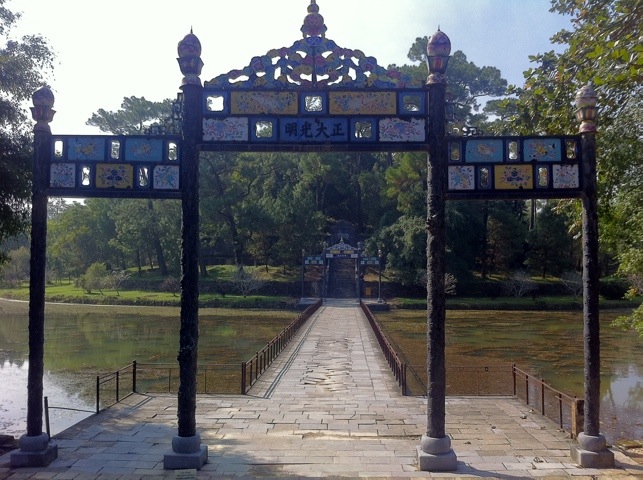
Laura as our culinary features editor), the city’s other main attraction is the wide Perfume River, winding its way through the centre, its banks home to a plethora of temples, pagodas and mausoleums. Fragranced it was (fortunately) not, it was one of the murkiest waterways we’ve been on, with lots of family-run operations dredging for stones and gravel from the bottom for use as building materials. We hired a boat for a day and took a pleasant trip south along to some of the sights, which really were worth seeing. There were a couple of very tranquil mausoleums set in acres of parkland, one with a gorgeous lake surrounding the burial mound. We also visited a Buddhist pagoda, with a working monastery, and former home to Thich Quang Duc, the monk who famously set fire to himself in front of the world’s press in Saigon in protest at President Diem’s regime. The infamous photo can be seen below, along with the car he drove there in.

20111123-182117.jpg

The Thien Mu Pagoda


20111123-182105.jpg

Thich Quang Duc's car and the famous photo

On reflection, there is actually one obvious contrast with China – for despite Vietnam’s troubled past, its modern persona is very much free and open, a marked difference to the visible repression we saw on the streets of Tibet, or the more subtle control over Tiennamen Square, and the mind games of Internet censorship in the ubiquitous Internet cafes heaving with young people playing online games. In that sense, here’s hoping this is a path in which China can follow Vietnam rather than the other way round.

Simon

20111123-182301.jpg

The burial mound at the Minh Mang mausoleum

A Vietnamese Disneyland?

20111120-201109.jpg

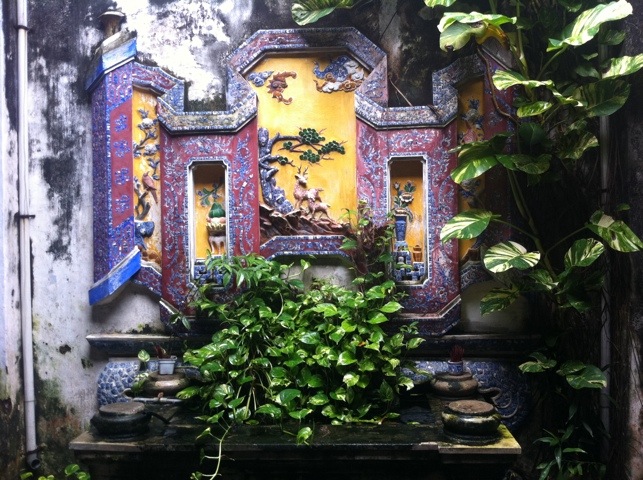
Decoration in an inner courtyard

Arriving in Hoi An, Laura pointed out that it seemed we’d taken taken a wrong turn and ended up in Disneyland.

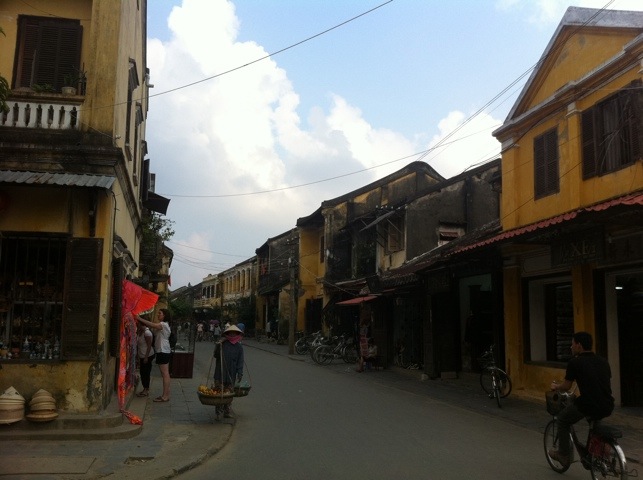
The streets were free from traffic, and full of groups of white tourists wandering round taking photos. All the buildings were beautifully maintained, a fabric of mustard yellow walls hemmed in by dark wooden beams, with dangling red chinese lanterns. There were street vendors on each corner, offering drinks and snacks – and ponchos when the downpour started. Even the locals seemed to be in costume (although not cartoon style), with far more of the Vietnamese cone bamboo hats than we’ve seen elsewhere. In little squares on street corners there were ‘cultural performances’ being put on for the tourists. Oh, and there was piped music playing in the streets, a background of classical strings and asian singing. Bizarre! Fortunately, the town’s savings grace was in what it was missing from Disneyland: no McDonalds, fairy castles, or Mickey Mouse – although there were a few rats around!

20111120-201511.jpg

A Hoi An street with mustard walls and red lanterns

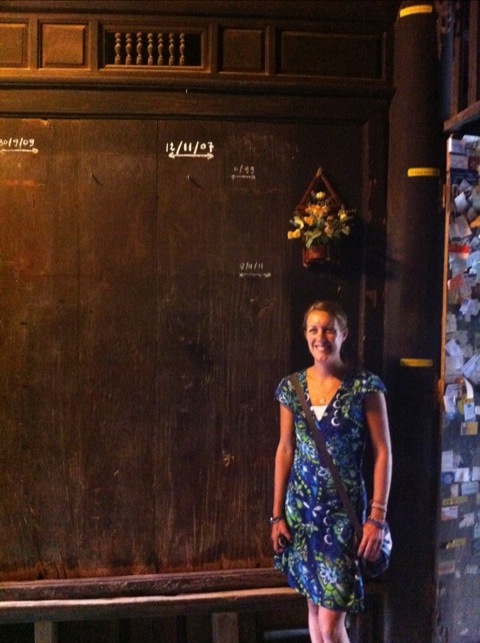
The town is a UNESCO world heritage site, an ancient port and former trading gateway to much of South East Asia’s interior, sitting on the banks of a large river estuary. It frequently floods as typhoon waters flow downstream from the nearby central highlands; our friend Sarah was here a week ago when the three streets nearest the river (most of the old town) were all under water – you can see the high water mark above Laura in a house we visited in the photo below!

20111120-200406.jpg

High water marks in an old house by the river

It may be quaint and twee and
somewhat of a facade for foreigners, but we did quite like the old part of town, with its interwoven patchwork of Chinese, Japanese and Vietnamese influences that had stemmed from distant traders settling permanently. It’s visually stunning, there’s a mouthwatering range of food, and it was wonderful to escape the drone of motorbikes we’ve had elsewhere – at times, you could hear a pin drop.

20111120-200935.jpg

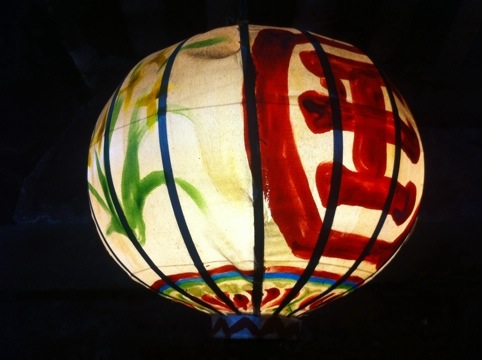
A painted lantern in the street

There’s also a good smattering of historic sites to visit, the most famous being the Japanese Bridge. The story goes that a Japanese earthquake had been attributed to a dragon with its head in India, tail in Japan, and heart in Hoi An. Coincidentally also providing the opportunity to span the river, the bridge was primarily constructed to pin the heart of the dragon down and prevent further catastrophes. I just hope the slightly dilapidated state of the bridge today was not connected with the disaster earlier this year!

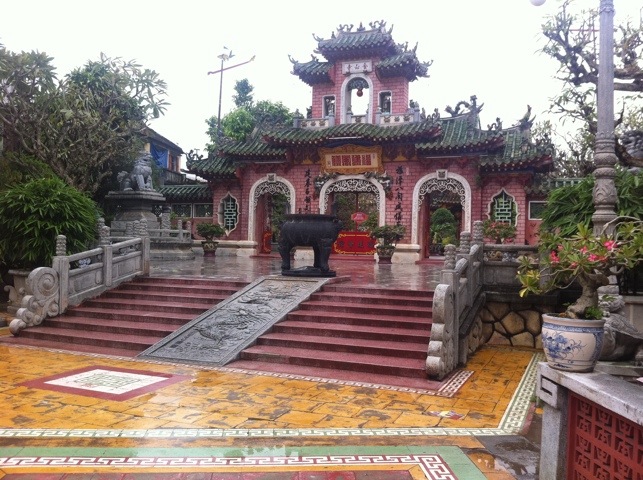
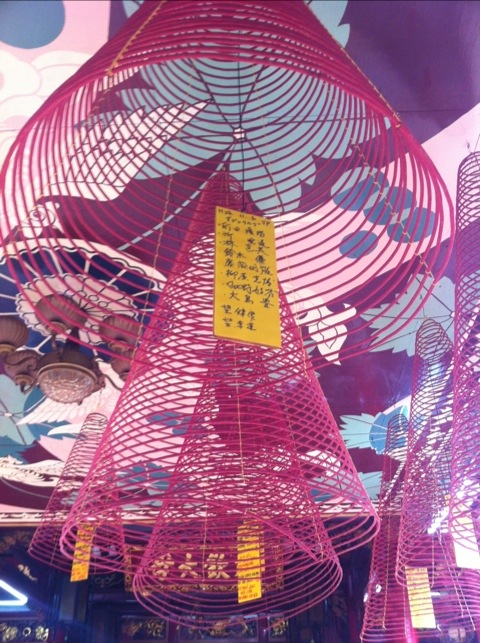
Elsewhere in the town are a set of five Chinese Assembly Halls, one for each of the different minority groups settled in the town. Going round a couple of these gave us a lovely flashback to our time in Beijing, with such glorious reds and golds and wonderful painted dragons on rooftops. They also had something striking we haven’t seen anywhere before – an array of huge coils of incense suspended from the ceiling, each with a memorial card hung inside. These were maybe a metre tall and a metre in diameter, very slowly filling the space with sweet smoke in memory of those that have passed away.

20111120-201348.jpg

One of the Chinese Assembly Halls

We also popped round an old house in the city, where we came across a ‘Confucius cup’, which preaches moderation by only functioning when less than 80% full. I’m not sure how well it would go down in pubs back in the UK though!

20111120-200920.jpg

Coils of hanging incense in the Assembly Hall

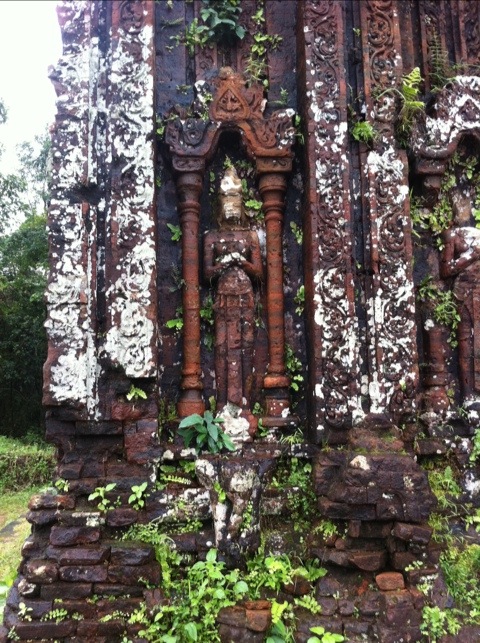
Another thread of history running through the area is that of the Champa dynasty and the holy site of Mỹ Sơn (pronounced mi sun). An expansive set of Hindu towers and temples, it was occupied by the Viet Cong during the American war (as they call it here, ‘Vietnam War’ doesn’t make much sense without context). As with much of Vietnam, this meant it was victim to heavy B52 bombing, and little of the site is still intact today. The ruins were interesting to look round, even if only as a glimpse of what once was – and to get some great photos of temples overrun by greenery.

20111120-200737.jpg

Stone carving at one of the temples at My Son

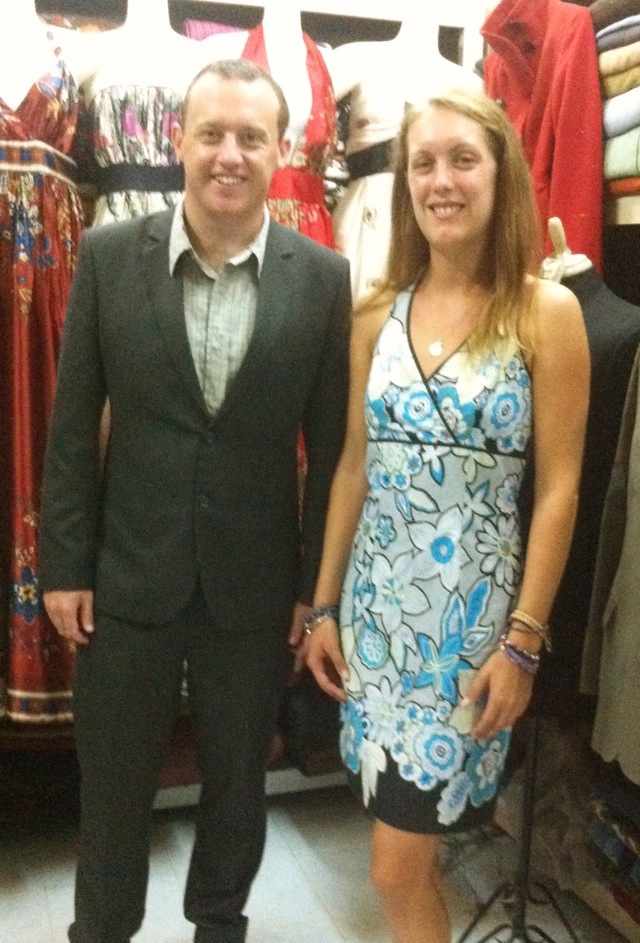
Finally, the city’s the place to come in Vietnam for personal tailoring, with a seam of shops offering a bewildering range of suits, coats, dresses and skirts at bargain prices. It felt like we got one of everything! Over the course of a hectic afternoon, Laura got dresses and a skirt, I got a suit, and we got some trousers and a coat for my sister. Each of these was custom made to order, some by the next day, and some the same day. Amazing!

I’ve never really been to a tailor before. It turns out there are a lot of questions you have to answer if you want a suit, or at least you need a Laura to help deflect them. Styles, colours, material, pleats, vents, pockets, piping, lining – and that’s before the 101 different dimensions for fitting! Anyway, we were both pretty pleased with the result – you can see us modelling our new clothing below. Feeling much smarter, we set off for Hue, safe in the knowledge that at least we’ll have some clean clothes when we finally make it back home!

Simon

20111120-195018.jpg

Our smart new clothes